What is the half-life of IgA in the blood compared to other antibody classes?
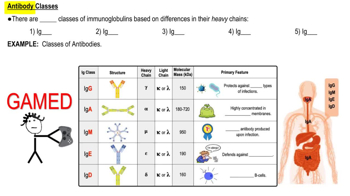
IgA has a medium half-life in the blood, which is shorter than the long half-life of IgG but longer than the short half-life of IgE and IgD.
What mnemonic can help you remember the five classes of antibodies?
The mnemonic 'GAMED' helps you remember the five classes: IgG, IgA, IgM, IgE, and IgD. Each letter stands for a different antibody class.
Which antibody class is most effective at activating the complement system via the classical pathway?
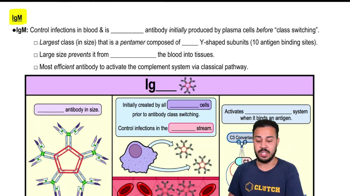
IgM is the most efficient antibody class at activating the complement system via the classical pathway. This is due to its pentameric structure with multiple antigen binding sites.
What structural feature distinguishes IgA from other antibody classes?
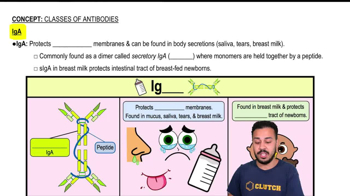
IgA is commonly found as a dimer, meaning it consists of two identical subunits held together by a peptide. This dimeric form is called secretory IgA.
Where are IgE antibodies primarily found and what cells do they interact with?
IgE antibodies are primarily found on the surface of basophils and mast cells. They interact with these cells to trigger degranulation and release of inflammatory mediators.
What is the main role of IgD antibodies in the immune system?
IgD antibodies are found on the surface of B cells and help signal B cell activation and maturation. This process leads to the differentiation of B cells into antibody-secreting plasma cells.
How does the large size of IgM affect its distribution in the body?
The large size of IgM prevents it from leaving the bloodstream and entering tissues. Therefore, its primary role is to control infections in the blood.
Which antibody class is most abundant in the blood and tissues?
IgG is the most abundant antibody class in the blood and tissues, making up about 80% of all immunoglobulins. It is considered the standard antibody.
How does secretory IgA in breast milk benefit newborns?
Secretory IgA in breast milk helps protect the intestinal tract of breastfed newborns. This provides important immune protection during early life.
What immune functions can IgG antibodies perform besides binding antigens?
IgG antibodies can activate the complement system via the classical pathway, leading to immune responses like inflammation and cell lysis. They also provide immunity to fetuses and newborns by crossing the placenta.