Covalent Bonds definitions Flashcards

Covalent Bonds definitions
Control buttons has been changed to "navigation" mode.
1/15
  • Covalent Bond
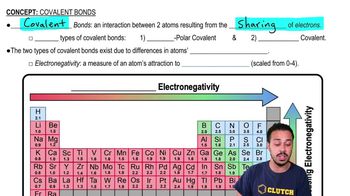
    An interaction between two atoms resulting from the sharing of electrons.
  • Nonpolar Covalent Bond
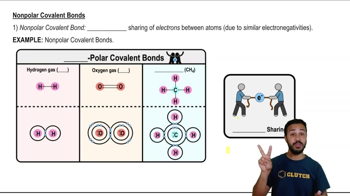
    Characterized by equal sharing of electrons between atoms with similar electronegativities.
  • Polar Covalent Bond
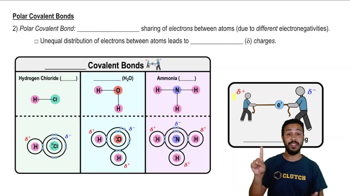
    Characterized by unequal sharing of electrons due to differences in electronegativity.
  • Electronegativity
    A measure of an atom's ability to attract electrons, ranging from 0 to 4.
  • Periodic Table
    Arrangement of elements reflecting trends in electronegativity, increasing from left to right and bottom to top.
  • Partial Charge
    A charge resulting from unequal distribution of electrons in polar covalent bonds.
  • Hydrogen Chloride
    A molecule with a polar covalent bond due to significant electronegativity difference between hydrogen and chlorine.
  • Water Molecule
    Composed of two hydrogen atoms and one oxygen atom, exhibiting polar covalent bonds.
  • Ammonia
    A molecule with one nitrogen and three hydrogen atoms, showing polar covalent bonds.
  • Methane
    A molecule with one carbon and four hydrogen atoms, exhibiting nonpolar covalent bonds.
  • Oxygen Gas
    Composed of two oxygen atoms sharing electrons equally, forming nonpolar covalent bonds.
  • Hydrogen Gas
    Consists of two hydrogen atoms sharing electrons equally, forming nonpolar covalent bonds.
  • Fluorine
    The most electronegative element, pulling electrons very strongly.
  • Delta Symbol
    Greek symbol used to denote partial charges in polar covalent bonds.
  • Electron Distribution
    Refers to how electrons are shared or distributed between atoms in a bond.