Skip to main content
Anatomy & Physiology
My Course
Learn
Exam Prep
AI Tutor
Study Guides
Textbook Solutions
Flashcards
Explore
Try the app
My Course
Learn
Exam Prep
AI Tutor
Study Guides
Textbook Solutions
Flashcards
Explore
Try the app
Back
Electrocardiogram (ECG) definitions
You can tap to flip the card.
Electrocardiogram
You can tap to flip the card.
👆
Electrocardiogram
A recording of the heart's electrical activity, used to assess heart function and diagnose conditions.
Track progress
Control buttons has been changed to "navigation" mode.
1/15
Related flashcards
Related practice
Recommended videos
Electrocardiogram (ECG) quiz #1
Electrocardiogram (ECG)
40 Terms
Electrocardiogram (ECG) quiz #2
Electrocardiogram (ECG)
29 Terms
Electrocardiogram (ECG) quiz #3
Electrocardiogram (ECG)
10 Terms
Electrocardiogram (ECG)
18. The Heart
4 problems
Topic
Jason
Cardiac Cycle
18. The Heart
7 problems
Topic
Jason
18. The Heart
4 topics
11 problems
Chapter
Jason
9:48
Electrocardiogram
7969
views
171
rank
2
comments
9:24
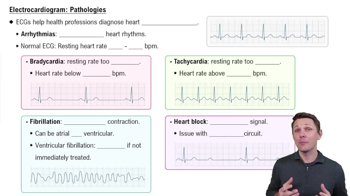
Electrocardiogram: Pathologies
5595
views
117
rank
1
comments
3:55
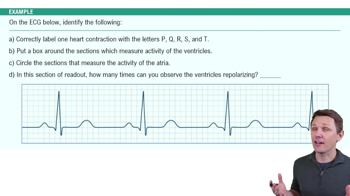
Electrocardiogram (ECG) Example 1
6101
views
129
rank
Terms in this set (15)
Hide definitions
Electrocardiogram
A recording of the heart's electrical activity, used to assess heart function and diagnose conditions.
Electrocardiograph
The machine that records the heart's electrical activity using electrodes placed on the body.
Depolarization
The process by which cardiac cells become electrically charged, leading to muscle contraction.
Repolarization
The process of cardiac cells returning to their resting electrical state after depolarization.
P wave
The part of an ECG that represents atrial depolarization.
QRS complex
The part of an ECG that represents ventricular depolarization.
T wave
The part of an ECG that represents ventricular repolarization.
Bradycardia
A condition where the heart rate is slower than normal, below 60 beats per minute.
Tachycardia
A condition where the heart rate is faster than normal, above 100 beats per minute.
Fibrillation
Uncoordinated contraction of heart muscle fibers, leading to ineffective pumping.
Atrial fibrillation
A type of fibrillation affecting the atria, often not immediately life-threatening.
Ventricular fibrillation
A type of fibrillation affecting the ventricles, usually fatal without immediate treatment.
Heart block
A condition where the electrical signal from the atria to the ventricles is disrupted.
AV node
A part of the heart's electrical conduction system that delays the signal before it reaches the ventricles.
ST segment
The flat section of an ECG between the QRS complex and the T wave, indicating ventricular contraction.
 BackBack
 9:48
9:48