Skip to main content
Anatomy & Physiology
My Course
Learn
Exam Prep
AI Tutor
Study Guides
Textbook Solutions
Flashcards
Explore
Try the app
My Course
Learn
Exam Prep
AI Tutor
Study Guides
Textbook Solutions
Flashcards
Explore
Try the app
Back
Electrocardiogram (ECG) quiz #1
2 students found this helpful
You can tap to flip the card.
What does the QRS wave of the electrocardiogram (ECG) represent?
You can tap to flip the card.
👆
What does the QRS wave of the electrocardiogram (ECG) represent?
The QRS wave represents ventricular depolarization.
Track progress
Control buttons has been changed to "navigation" mode.
1/40
Related flashcards
Related practice
Recommended videos
Electrocardiogram (ECG) definitions
Electrocardiogram (ECG)
15 Terms
Electrocardiogram (ECG) quiz #2
Electrocardiogram (ECG)
29 Terms
Electrocardiogram (ECG) quiz #3
Electrocardiogram (ECG)
10 Terms
Electrocardiogram (ECG)
18. The Heart
4 problems
Topic
Jason
Cardiac Cycle
18. The Heart
7 problems
Topic
Jason
18. The Heart
4 topics
11 problems
Chapter
Jason
9:48
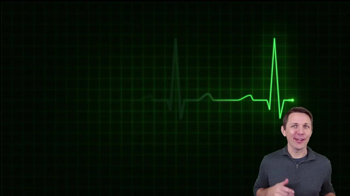
Electrocardiogram
7961
views
171
rank
2
comments
9:24
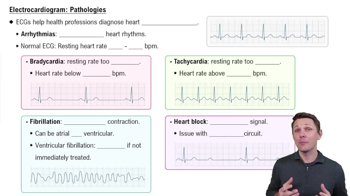
Electrocardiogram: Pathologies
5588
views
117
rank
1
comments
3:55
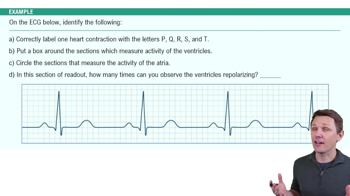
Electrocardiogram (ECG) Example 1
6096
views
129
rank
Terms in this set (40)
Hide definitions
What does the QRS wave of the electrocardiogram (ECG) represent?
The QRS wave represents ventricular depolarization.
Which wave on the electrocardiogram (ECG) represents ventricular depolarization?
The QRS complex represents ventricular depolarization.
Which ECG component corresponds to the depolarization of the atria?
The P wave corresponds to the depolarization of the atria.
The client asks the nurse what the small P wave on her ECG indicates. What would the nurse answer?
The P wave indicates atrial depolarization.
Which portion of the ECG corresponds to repolarization of the atria?
Atrial repolarization is not visible on the ECG as it occurs during the QRS complex.
During which part of this ECG are the ventricles repolarizing?
The ventricles are repolarizing during the T wave.
How many leads are in a standard ECG?
A standard ECG has 12 leads.
What does the T wave represent?
The T wave represents ventricular repolarization.
Which part of the ECG wave represents ventricular contraction?
QRS complex
Which component of the ECG cycle shows ventricular depolarization?
The QRS complex shows ventricular depolarization.
Which wave represents ventricular repolarization?
The T wave represents ventricular repolarization.
In an electrocardiogram, what does the P wave represent?
The P wave represents atrial depolarization.
What part of the ECG tracing represents ventricular depolarization?
The QRS complex represents ventricular depolarization.
Which wave of the ECG cycle shows atrial depolarization?
The P wave shows atrial depolarization.
Which part of an electrocardiogram corresponds to the contraction of the atria?
The P wave corresponds to the contraction of the atria.
During which part of this ECG are the atria repolarizing?
Atrial repolarization occurs during the QRS complex but is not visible.
Which ECG component corresponds to the depolarization of the ventricles?
The QRS complex corresponds to the depolarization of the ventricles.
Which component of an electrocardiogram (ECG) represents atrial depolarization?
The P wave represents atrial depolarization.
What part of an electrocardiogram (ECG) represents ventricular repolarization?
The T wave represents ventricular repolarization.
Which ECG wave represents atrial contraction?
P wave
What does the QRS complex represent on an electrocardiogram waveform?
The QRS complex represents ventricular depolarization.
What does the T wave of an ECG represent?
Ventricular repolarization
What is the most appropriate patient position for a diagnostic 12-lead ECG?
The patient should be in a supine position.
Which component of the ECG represents the depolarization of the atria?
The P wave represents the depolarization of the atria.
What portion of the ECG depicts ventricular depolarization?
The QRS complex depicts ventricular depolarization.
Which wave in an electrocardiogram represents repolarization of the ventricles?
The T wave represents repolarization of the ventricles.
During which part of this ECG are the atria depolarizing?
The atria are depolarizing during the P wave.
Which ECG wave represents depolarization of the ventricles?
QRS complex
What indicates ventricular depolarization on an ECG?
QRS complex
Which electrocardiogram (ECG) finding can be used to measure heart rate?
The R-R interval can be used to measure heart rate.
Which ECG segment represents atrial depolarization?
The P wave represents atrial depolarization.
What cardiac parameter can the ECG detect?
Heart rate
Which component of an ECG tracing represents ventricular repolarization?
The T wave represents ventricular repolarization.
What ECG component corresponds to the time it takes for the ventricles to contract?
The QRS complex corresponds to the time it takes for the ventricles to contract.
Which wave on the ECG shows the repolarization of the ventricles?
The T wave shows the repolarization of the ventricles.
What part of the ECG pattern is due to depolarization of the ventricles?
The QRS complex is due to depolarization of the ventricles.
Which EEG pattern is associated with problem-solving?
Beta waves are associated with problem-solving.
Which ECG wave indicates that the ventricles are about to contract?
QRS complex
What indicates a normal sinus rhythm on an ECG?
Regular P waves followed by QRS complexes
Which ECG wave represents ventricular depolarization?
QRS complex
 BackBack
 9:48
9:48