Which organelles contain digestive enzymes and are responsible for breaking down and recycling cellular debris, food, and damaged organelles in animal cells?
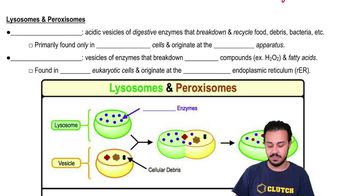
Lysosomes are organelles that contain digestive enzymes and are responsible for breaking down and recycling cellular debris, food, and damaged organelles in animal cells.
What is the main difference in the cellular location of lysosomes and peroxisomes?
Lysosomes are primarily found in animal cells, while peroxisomes are found in all eukaryotic cells, including both animal and plant cells.
From which organelle do lysosomes originate?
Lysosomes originate from the Golgi apparatus, where they are formed as vesicles containing digestive enzymes.
What toxic compound do peroxisomes help break down in cells?
Peroxisomes help break down hydrogen peroxide, a toxic compound, into non-toxic components.
How do lysosomes interact with other vesicles to perform their function?
Lysosomes can fuse with other vesicles, exposing their digestive enzymes to the vesicle's contents for breakdown and recycling.
What is one key function of peroxisomes besides breaking down hydrogen peroxide?
Peroxisomes are also important for breaking down fatty acids within the cell.
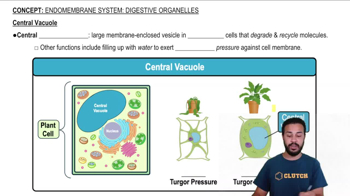
Which plant cell organelle is responsible for exerting turgor pressure?
The central vacuole is responsible for storing water and exerting turgor pressure against the cell membrane in plant cells.
What happens to a plant cell when it loses water from its central vacuole?
When a plant cell loses water from its central vacuole, turgor pressure drops, which can cause the plant to wilt and become unhealthy.
How does high turgor pressure affect the structure of a plant?
High turgor pressure helps maintain the plant's upright structure and supports its healthy state.
What is a shared structural feature of lysosomes and peroxisomes?
Both lysosomes and peroxisomes are vesicles, meaning they are small membrane-enclosed bubbles within the cell.