Why do muscle cells use lactic acid fermentation during intense exercise when oxygen is scarce?
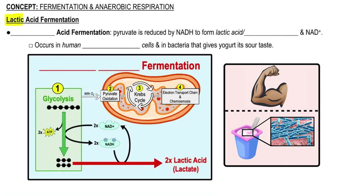
Muscle cells use lactic acid fermentation to regenerate NAD+ from NADH, allowing glycolysis to continue and produce a small amount of ATP even when oxygen is not available. This process enables muscles to generate energy anaerobically for a short period.
What happens to the electron transport chain when oxygen is not available in aerobic organisms?
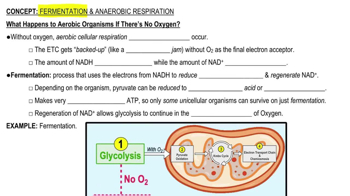
The electron transport chain becomes backed up because there is no final electron acceptor. This causes NADH levels to rise and NAD+ levels to fall dangerously low.
Why is the regeneration of NAD+ during fermentation critical for glycolysis?
Regeneration of NAD+ allows glycolysis to continue producing ATP even when oxygen is absent. Without NAD+, glycolysis would stop and no ATP would be made.
What are the two main products that pyruvate can be reduced to during fermentation depending on the organism?
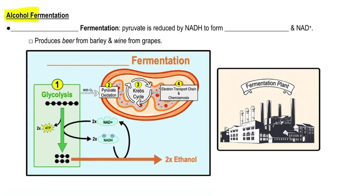
Pyruvate can be reduced to either lactic acid or ethanol during fermentation. The specific product depends on the type of organism performing the fermentation.
Why can't multicellular organisms survive on fermentation alone for energy production?
Fermentation produces only a small amount of ATP, which is insufficient for the energy needs of multicellular organisms. They require more ATP than fermentation can provide.
How does lactic acid fermentation contribute to the sour taste of yogurt?
Lactic acid fermentation in bacteria produces lactic acid, which gives yogurt its sour taste. The accumulation of lactic acid lowers the pH, resulting in the characteristic flavor.
What is the main difference between lactic acid fermentation and alcohol fermentation?
The main difference is that lactic acid fermentation produces lactic acid, while alcohol fermentation produces ethanol. Both processes regenerate NAD+ but yield different end products.
Which alternative molecules can serve as final electron acceptors in anaerobic respiration?
Nitrate (NO3-), sulfate (SO42-), and carbon dioxide can serve as final electron acceptors in anaerobic respiration. These replace oxygen in the electron transport chain.
How does the amount of ATP produced by anaerobic respiration compare to fermentation and aerobic respiration?
Anaerobic respiration produces more ATP than fermentation but less than aerobic respiration. Aerobic respiration yields the most ATP overall.
What allows some unicellular organisms to survive without oxygen while multicellular organisms cannot?
Some unicellular organisms can survive on the small amount of ATP produced by fermentation or anaerobic respiration. Multicellular organisms require much more ATP, which these processes cannot supply.