Which hormone is primarily responsible for increasing water reabsorption in the kidneys to promote water retention?
The antidiuretic hormone (ADH), also known as vasopressin, is primarily responsible for increasing water reabsorption in the kidneys, leading to water retention.
What term describes a person who has a low blood volume?
A person with low blood volume is said to be hypovolemic.
What is the main function of the juxtaglomerular (JG) cells in the kidney?
The JG cells detect drops in blood pressure or blood volume and release the protein renin to initiate the RAAS pathway. This helps restore normal blood volume and pressure.
How does angiotensin II affect blood vessels to influence blood pressure?
Angiotensin II causes vasoconstriction, which narrows the blood vessels. This increases blood pressure by making it harder for blood to flow through the vessels.
What role does the enzyme ACE play in the RAAS pathway?
ACE (angiotensin converting enzyme) converts angiotensin I into angiotensin II. This step is crucial for activating the effects of angiotensin II on blood pressure and volume.
Why do desert-dwelling animals often excrete uric acid instead of urea or ammonia?
Desert-dwelling animals excrete uric acid because it is almost insoluble and can be eliminated with minimal water loss. This adaptation helps them conserve water in extremely dry environments.
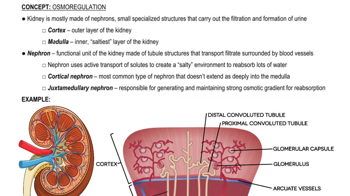
What is the difference between cortical and juxtamedullary nephrons in the kidney?
Cortical nephrons are more common and have tubules that extend only slightly into the medulla, while juxtamedullary nephrons extend deeply into the medulla. Juxtamedullary nephrons help maintain the osmotic gradient necessary for water reabsorption.
How does aldosterone increase blood volume without making the blood too salty?
Aldosterone stimulates the reabsorption of salt in the kidney, and water follows by osmosis, increasing blood volume. The simultaneous reabsorption of water prevents the blood from becoming overly salty.
What triggers the negative feedback that stops renin production in the RAAS system?
When blood volume and pressure return to normal, the kidneys detect this and send a negative feedback signal to the JG cells. This signal stops renin production and halts the RAAS pathway.
How can the sympathetic nervous system activate the RAAS pathway during emergencies?
The sympathetic nervous system can stimulate the pituitary hormone ACTH, which increases aldosterone production. This raises blood pressure and volume to ensure adequate blood supply to organs during fight or flight situations.
 Back
Back
 02:59
02:59