Which hormone elevation is commonly used as an indicator for Turner syndrome?
Elevated levels of follicle-stimulating hormone (FSH) are commonly used as an indicator for Turner syndrome, due to ovarian dysgenesis leading to increased FSH.
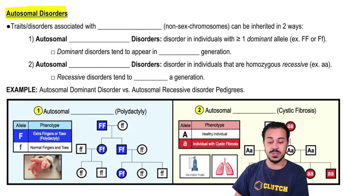
What is the key difference in allele requirements for expression of autosomal dominant versus autosomal recessive disorders?
Autosomal dominant disorders require at least one dominant allele for expression, while autosomal recessive disorders require two recessive alleles. This means dominant disorders can appear in heterozygotes, but recessive disorders only appear in homozygotes.
How do autosomal dominant disorders typically appear in family pedigrees?
Autosomal dominant disorders usually appear in every generation without skipping. This is because only one dominant allele is needed for the disorder to be expressed.
Why do autosomal recessive disorders often skip generations in pedigrees?
Autosomal recessive disorders skip generations because carriers with only one recessive allele do not show symptoms. The disorder only appears when two carriers have a child who inherits both recessive alleles.
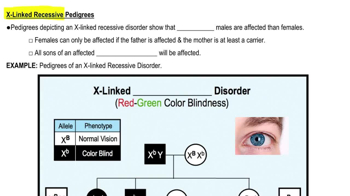
What genotype must a female have to express an X-linked recessive disorder?
A female must be homozygous recessive, meaning she has two copies of the recessive allele on both X chromosomes. This is less common than in males, who only need one recessive allele.
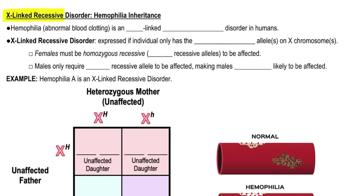
Why are males more likely to be affected by X-linked recessive disorders than females?
Males have only one X chromosome, so a single recessive allele will cause the disorder. Females need two recessive alleles, making it less likely for them to be affected.
In X-linked recessive pedigrees, under what parental conditions can a female be affected?
A female can be affected if her father is affected and her mother is either a carrier or also affected. This ensures she receives two recessive alleles.
What is the inheritance outcome for all sons of a female affected by an X-linked recessive disorder?
All sons of an affected female will inherit the disorder. This is because they receive their only X chromosome from their mother, which carries the recessive allele.
What is a classic example of an autosomal dominant disorder discussed in the lesson?
Polydactyly, which results in extra fingers or toes, is a classic example of an autosomal dominant disorder. Individuals with at least one dominant allele will express this trait.
Which X-linked recessive disorder is characterized by abnormal blood clotting?
Hemophilia is an X-linked recessive disorder characterized by abnormal blood clotting. It is more common in males due to their single X chromosome.
 Back
Back
 05:21
05:21