Graded Potentials definitions Flashcards

Graded Potentials definitions
Control buttons has been changed to "navigation" mode.
1/15
  • Graded Potentials
    Changes in membrane potential occurring in the soma and dendrites, influenced by synaptic activity.
  • Chemical Synapses
    The most common type of synapse in the human body, facilitating neuron communication.
  • Postsynaptic Potentials
    Membrane potential changes at the postsynaptic terminal, can be excitatory or inhibitory.
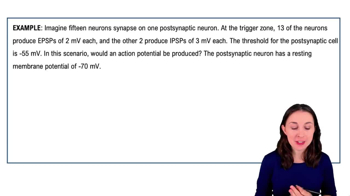
  • Excitatory Postsynaptic Potential (EPSP)
    Depolarizes the membrane, increasing the likelihood of an action potential.
  • Inhibitory Postsynaptic Potential (IPSP)
    Hyperpolarizes the membrane, decreasing the likelihood of an action potential.
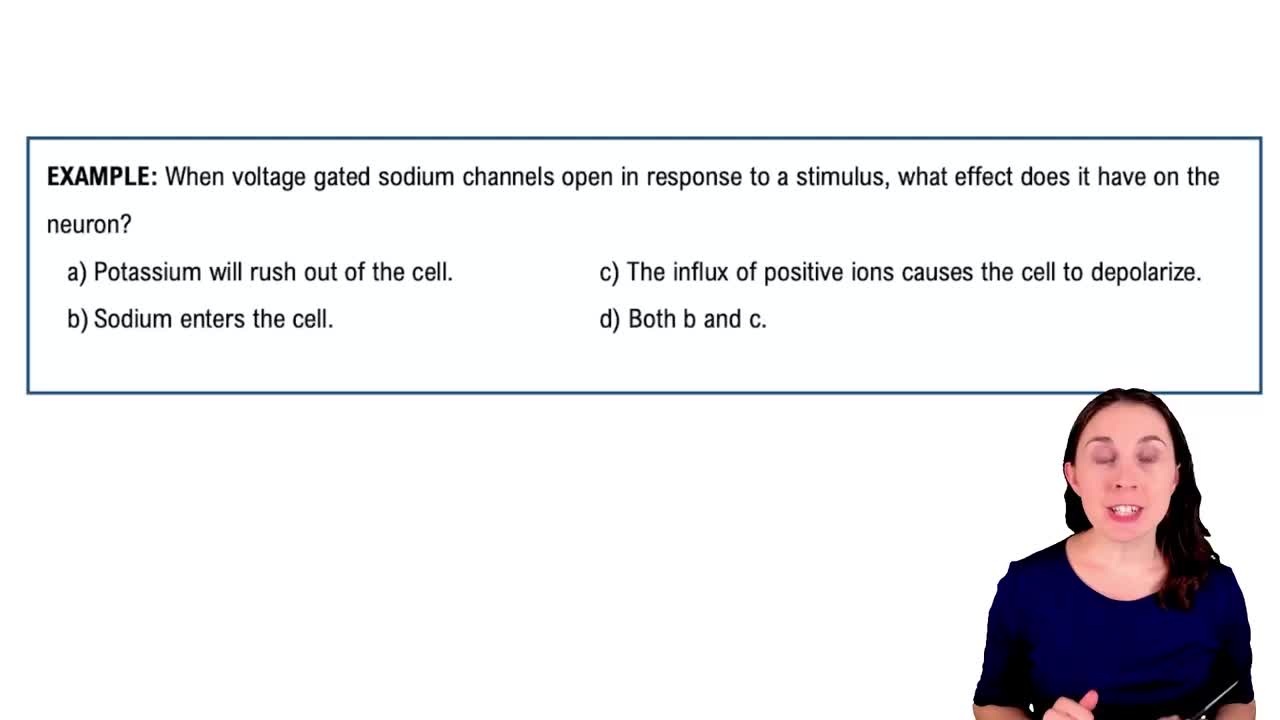
  • Depolarization
    A process where the membrane potential becomes more positive due to sodium ion influx.
  • Hyperpolarization
    A process where the membrane potential becomes more negative, inhibiting action potential.
  • Sodium Channels
    Gated channels that open to allow sodium ions into the cell, causing depolarization.
  • Leak Channels
    Channels that allow ions to passively diffuse across the membrane, affecting potential.
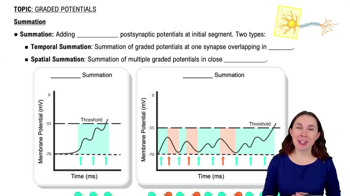
  • Summation
    The additive effect of multiple postsynaptic potentials to reach action potential threshold.
  • Temporal Summation
    Summation of graded potentials from one synapse overlapping in time.
  • Spatial Summation
    Summation of graded potentials from multiple synapses in close proximity.
  • Threshold
    The membrane potential level that must be reached to trigger an action potential.
  • Action Potential
    A rapid rise and fall in membrane potential that propagates along the neuron.
  • Neuron
    A nerve cell that transmits signals through electrical and chemical means.