Back

Graded Potentials quiz

Control buttons has been changed to "navigation" mode.
1/9
  • What is an accurate statement concerning graded potentials?

    They can summate to influence action potential generation.
  • What are the two types of postsynaptic potentials?

    The two types of postsynaptic potentials are excitatory postsynaptic potentials (EPSPs) and inhibitory postsynaptic potentials (IPSPs).
  • How do EPSPs affect the membrane potential?

    EPSPs depolarize the membrane, making it more positive and increasing the likelihood of an action potential.
  • What is the role of sodium ions in depolarizing graded potentials?

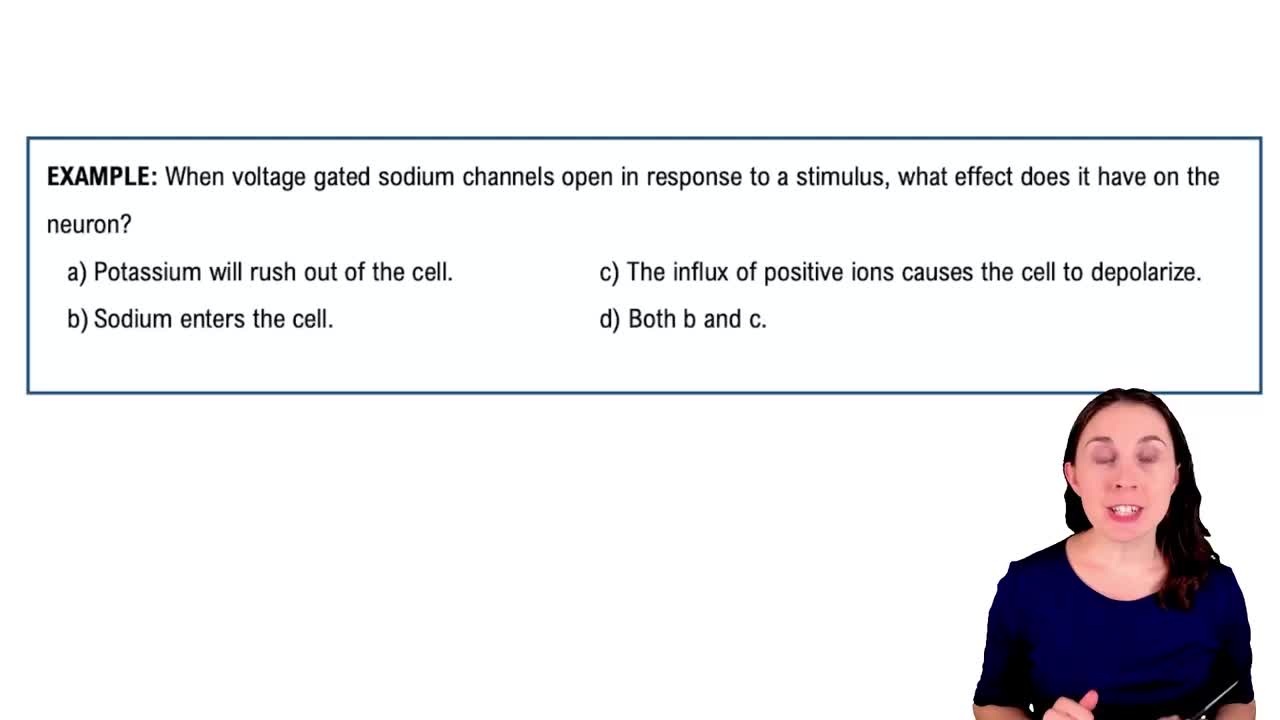
    Sodium ions enter the cell through gated channels, causing depolarization by making the inside of the cell more positive.
  • What happens to a graded potential as it spreads across the membrane?

    As a graded potential spreads, it diminishes in strength due to the loss of sodium ions through leak channels.
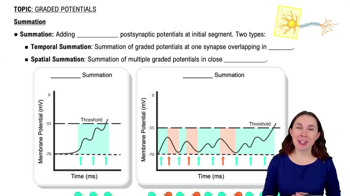
  • What is temporal summation?

    Temporal summation is the additive effect of multiple signals from a single neuron overlapping in time.
  • What is spatial summation?

    Spatial summation involves the additive effect of multiple graded potentials from different synapses located close to each other.
  • How can IPSPs affect the likelihood of an action potential?

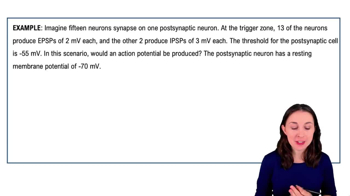
    IPSPs hyperpolarize the membrane, making it more negative and decreasing the likelihood of an action potential.
  • What is required for summation to trigger an action potential?

    Summation must depolarize the membrane to reach the threshold of negative 55 millivolts to trigger an action potential.