Gross Anatomy of Bone: Short, Flat, and Irregular Bones quiz Flashcards

Gross Anatomy of Bone: Short, Flat, and Irregular Bones quiz
1 student found this helpful
Control buttons has been changed to "navigation" mode.
1/10
  • Which of the following bones is accurately described as an irregular bone?
    The vertebrae is accurately described as an irregular bone.
  • Which of the following is classified as a short bone?
    Bones like the carpals in the wrist are classified as short bones.
  • What type of bone is the vertebrae classified as?
    The vertebrae is classified as an irregular bone.
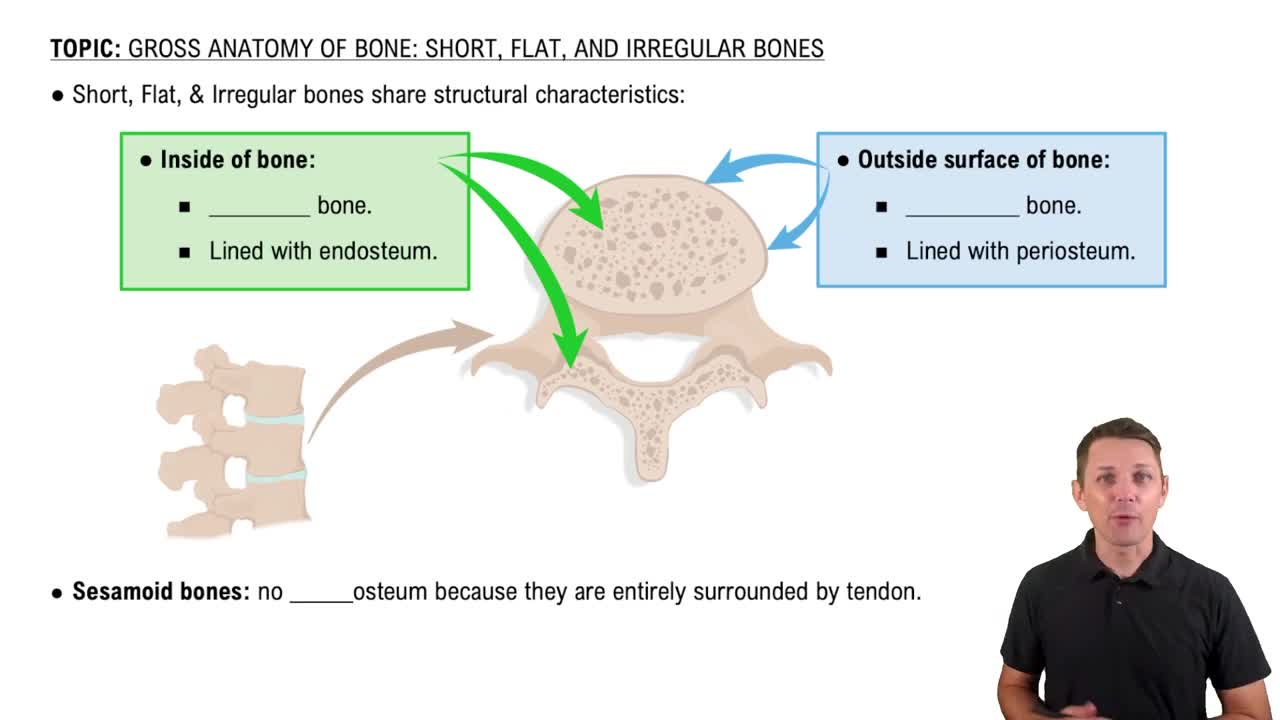
  • What is the main characteristic of spongy bone in irregular bones?
    Spongy bone in irregular bones is characterized by its porous structure and is lined with endosteum.
  • What is the function of compact bone in irregular bones?
    Compact bone provides strength, protection, and structure to irregular bones.
  • What is the periosteum and where is it found?
    The periosteum is a layer that surrounds the outside of bones, except sesamoid bones, and contains an osteogenic layer and a fibrous layer.
  • Why do sesamoid bones lack periosteum?
    Sesamoid bones lack periosteum because they are entirely enclosed within a tendon.
  • What is the role of the osteogenic layer in the periosteum?
    The osteogenic layer in the periosteum contains bone stem cells that contribute to bone growth and repair.
  • What distinguishes sesamoid bones from other bone types?
    Sesamoid bones are distinguished by being completely enclosed within a tendon and lacking periosteum.
  • What is the primary structural difference between long bones and other bone types discussed?
    Long bones have a unique structure that will be covered in more detail separately, unlike short, flat, irregular, and sesamoid bones.