What is the central principle of physiology, and why is it important?
The central principle of physiology is homeostasis, which is the maintenance of a stable internal environment. It is important because it underpins most physiological processes and is essential for health; failure to maintain homeostasis can lead to disease or pathology.
In anatomy and physiology, what does dynamic equilibrium mean in the context of homeostasis?
Dynamic equilibrium in homeostasis refers to the body's ability to maintain internal stability by constantly adjusting to external changes. The internal environment is kept within a narrow range, but it is not static; the body is always actively working to regulate factors like temperature, fluid, and nutrient levels.
What does the Greek root 'homeo' mean in the word 'homeostasis'?
'Homeo' comes from the Greek word meaning similar or the same. It refers to the body's effort to keep internal conditions consistent.
Which internal factors are regulated by homeostasis according to the transcript?
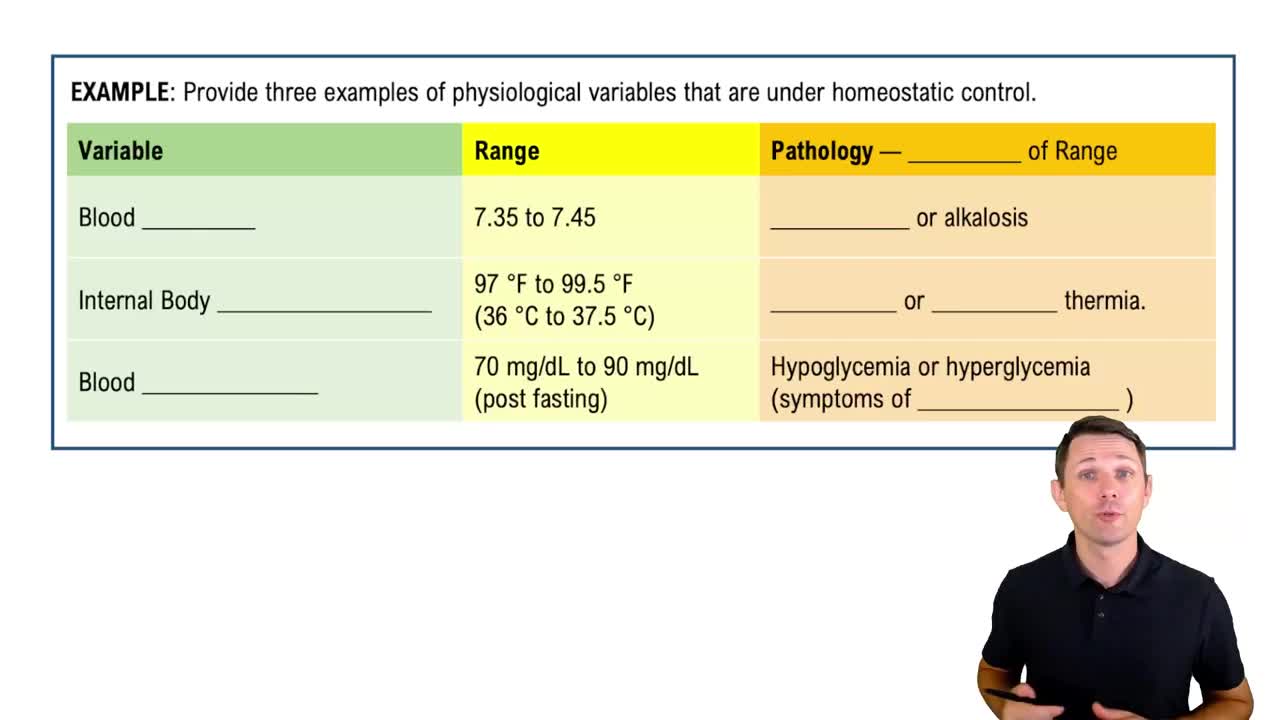
Homeostasis regulates fluid levels, nutrient levels, body chemistry, waste levels, oxygen levels, and body temperature. These factors are kept within a narrow range for proper function.
How does the body respond to changing external conditions to maintain homeostasis?
The body constantly works to adjust internal conditions in response to external changes. This ongoing adjustment is necessary to keep internal variables within a healthy range.
What visual example was used in the transcript to illustrate homeostasis?
The transcript described a woman in the cold and a man in the heat to show that, despite different environments, their body temperatures remain similar. This demonstrates the body's ability to maintain internal stability.
What happens when the body fails to maintain homeostasis?
Failure to maintain homeostasis results in a disease state or pathology. This means the body's internal environment is no longer stable, leading to health problems.
Why is homeostasis described as a dynamic process rather than a static one?
Homeostasis is dynamic because the body is always changing and adjusting to maintain stability. It is not a fixed state but involves continuous regulation.
What term is used in anatomy and physiology to refer to a disease state caused by loss of homeostasis?
The term 'pathology' is used to describe a disease state resulting from the failure of homeostasis. This term is commonly used in anatomy and physiology.
Why is understanding homeostasis considered essential for studying physiology?
Homeostasis is the foundational concept underlying most physiological processes. Without understanding it, one cannot fully grasp how the body functions or responds to changes.