Skip to main content
Anatomy & Physiology
My Course
Learn
Exam Prep
AI Tutor
Study Guides
Textbook Solutions
Flashcards
Explore
Try the app
My Course
Learn
Exam Prep
AI Tutor
Study Guides
Textbook Solutions
Flashcards
Explore
Try the app
Back
Integumentary System: Thermoregulation quiz
You can tap to flip the card.
What may happen to the skin if an area is subject to pressure or friction?
You can tap to flip the card.
👆
What may happen to the skin if an area is subject to pressure or friction?
The skin may develop calluses or blisters due to increased cell production and thickening of the skin in response to pressure or friction.
Track progress
Control buttons has been changed to "navigation" mode.
1/32
Related flashcards
Related practice
Recommended videos
Integumentary System: Thermoregulation definitions
Integumentary System: Thermoregulation
10 Terms
Integumentary System: Thermoregulation quiz #1
Integumentary System: Thermoregulation
10 Terms
Integumentary System: Thermoregulation
5. Integumentary System
1 problem
Topic
Bruce
The Epidermis: Cells
5. Integumentary System
6 problems
Topic
Bruce
5. Integumentary System - Part 1 of 2
4 topics
8 problems
Chapter
Bruce
5. Integumentary System - Part 2 of 2
5 topics
8 problems
Chapter
Bruce
Guided course
01:07
Introduction to Thermoregulation
12063
views
250
rank
Guided course
05:07
Vasoconstriction & Vasodilation
12456
views
227
rank
1
comments
Guided course
02:00
Integumentary System: Thermoregulation Example 1
8857
views
170
rank
1
comments
Terms in this set (32)
Hide definitions
What may happen to the skin if an area is subject to pressure or friction?
The skin may develop calluses or blisters due to increased cell production and thickening of the skin in response to pressure or friction.
How do the muscles help in thermoregulation?
Muscles help in thermoregulation by generating heat through shivering, which is an involuntary contraction of muscles to produce warmth.
Which part of the brain regulates body temperature?
The hypothalamus regulates body temperature by triggering responses such as sweating or shivering.
The action of what helps reduce heat loss through the skin?
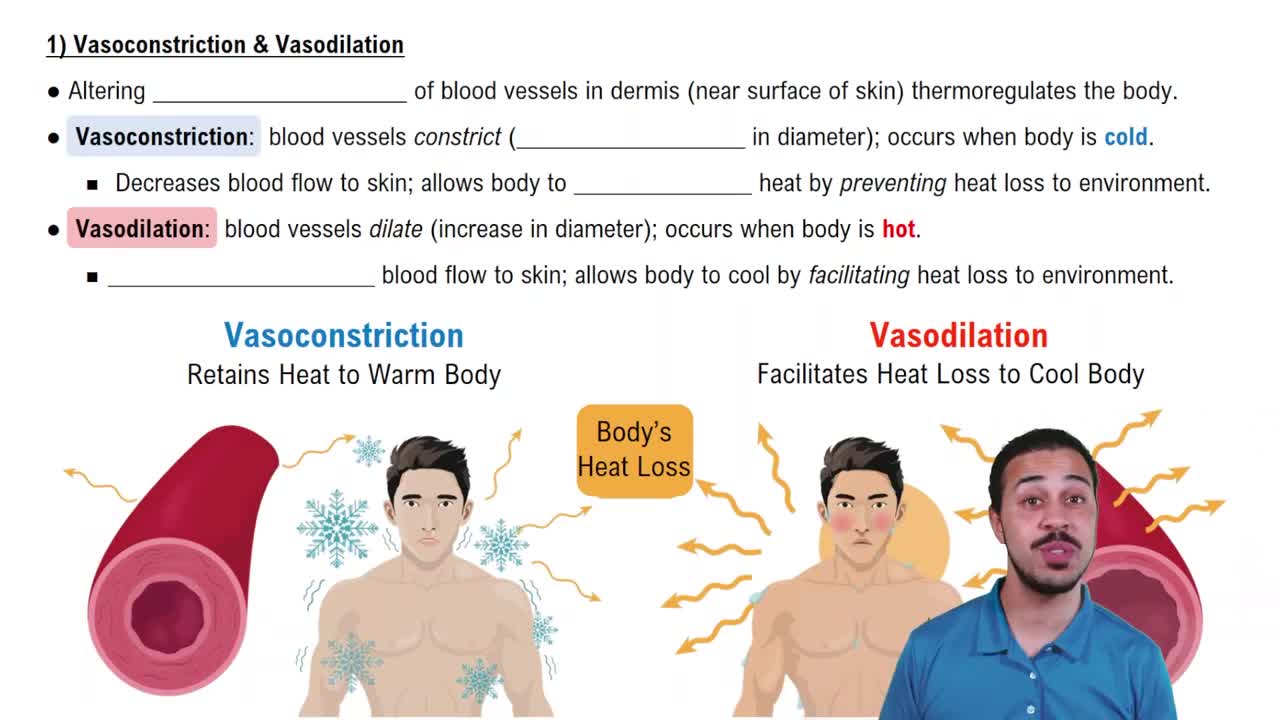
Vasoconstriction helps reduce heat loss through the skin by decreasing blood flow to the skin's surface.
Why is sweating an effective way to cool the body?
Sweating is effective because the evaporation of sweat from the skin surface removes heat, cooling the body.
How do muscles contribute to maintaining body temperature?
Muscles maintain body temperature by generating heat through shivering and increasing metabolic activity.
How does vasodilation of dermal blood vessels help to decrease body temperature?
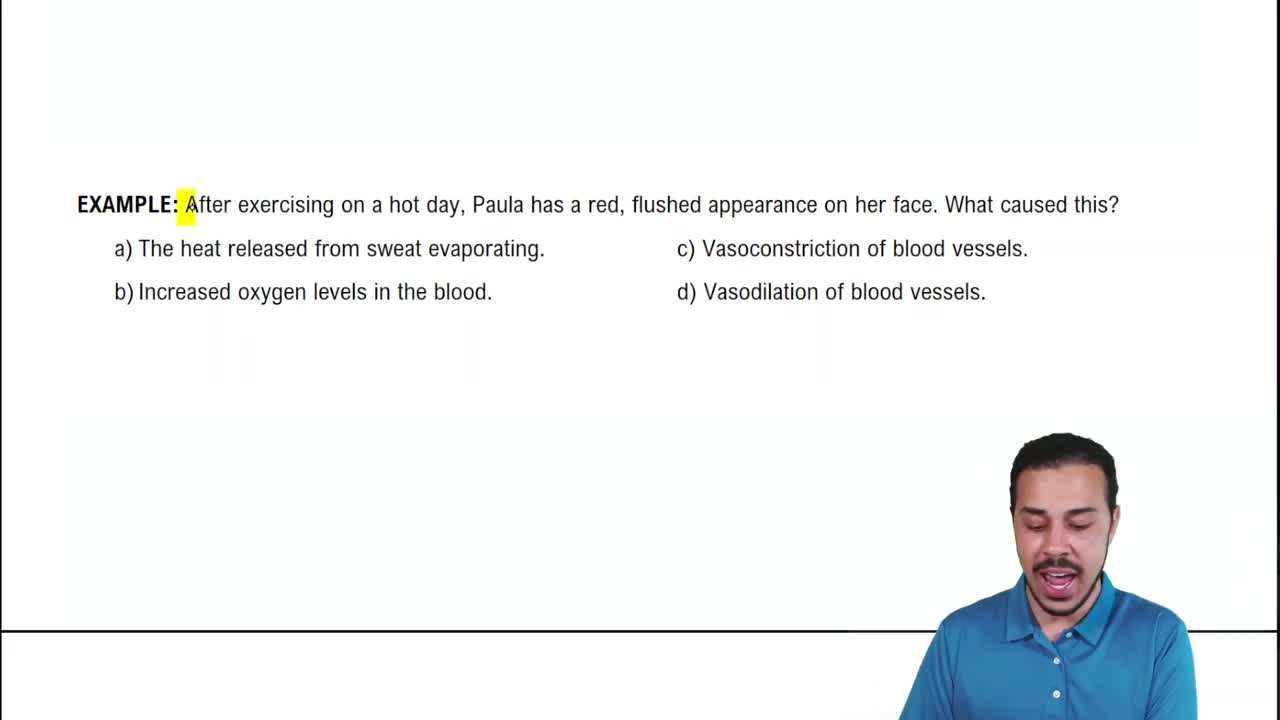
Vasodilation increases blood flow to the skin, allowing more heat to radiate away from the body, thus cooling it.
What happens when the high heat molecules leave your skin?
When high heat molecules leave your skin, it results in a cooling effect as heat is transferred away from the body.
What is water loss caused by evaporation on the skin's surface?
Water loss caused by evaporation on the skin's surface is known as insensible perspiration.
Cold weather can change what aspect of a Himalayan rabbit?
Cold weather can change the fur color of a Himalayan rabbit, causing it to darken in cooler areas.
How does sweating help with thermoregulation?
Sweating helps with thermoregulation by releasing sweat onto the skin, which evaporates and cools the body.
Most radiant heat is lost through which part(s) of the body?
Most radiant heat is lost through the skin, particularly areas with high blood flow like the face and extremities.
Which is the best example of water regulating an organism’s body temperature?
Sweating in humans is the best example, as it uses water to dissipate heat through evaporation.
What is a major function of the sudoriferous gland?
A major function of the sudoriferous gland is to produce sweat for thermoregulation.
The nurse would use what part of the hand when assessing temperature during palpation?
The nurse would use the back of the hand to assess temperature during palpation.
Sweating results in loss of body heat by what means?
Sweating results in loss of body heat through evaporation.
What process allows your body to cool off on a hot day?
Sweating and the subsequent evaporation of sweat allow your body to cool off on a hot day.
When the weather is very hot, what physiological response occurs to help cool the body?
When the weather is very hot, vasodilation and increased sweating occur to help cool the body.
Which body system regulates temperature and produces vitamin D?
The integumentary system regulates temperature and produces vitamin D.
Goosebumps are caused by the contraction of what?
Goosebumps are caused by the contraction of arrector pili muscles.
What physiological response occurs in the body to prevent heat loss?
Vasoconstriction occurs
What is the best way to assess a patient's skin temperature by touch?
Use the back of the hand
How does the muscular system help maintain body temperature?
The muscular system helps maintain body temperature through shivering, which generates heat.
How does sweating help the body cool down?
Sweating helps the body cool down by releasing sweat that evaporates, removing heat from the skin.
What are two features of temperature regulation in skin?
Two features of temperature regulation in skin are vasodilation/vasoconstriction and sweating.
What is the pigment that absorbs ultraviolet light to tan the skin?
Melanin is the pigment that absorbs ultraviolet light to tan the skin.
Which structure in the skin plays an important role in thermoregulation?
Sweat glands
How does the integumentary system help maintain homeostasis?
The integumentary system helps maintain homeostasis by regulating body temperature and protecting against environmental damage.
What is one of the body's normal cooling mechanisms?
One of the body's normal cooling mechanisms is sweating.
Which system produces the body's heat?
The muscular system produces the body's heat through metabolic activity and shivering.
What role does your skin play in the regulation of body temperature?
The skin regulates body temperature through vasodilation, vasoconstriction, and sweating.
Which animal will be able to control its body temperature the best? A) Reptile B) Amphibian C) Mammal D) Fish
C) Mammal
 BackBack

 01:07
01:07