Skip to main content
Anatomy & Physiology
My Course
Learn
Exam Prep
AI Tutor
Study Guides
Textbook Solutions
Flashcards
Explore
Try the app
My Course
Learn
Exam Prep
AI Tutor
Study Guides
Textbook Solutions
Flashcards
Explore
Try the app
Back
Intracellular Receptors and Direct Gene Action definitions
1 student found this helpful
You can tap to flip the card.
Steroid Hormones
You can tap to flip the card.
👆
Steroid Hormones
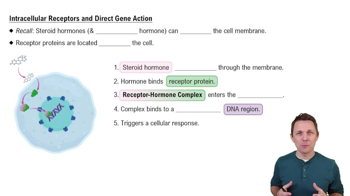
Lipid-soluble hormones that can pass through cell membranes to influence gene expression directly.
Track progress
Control buttons has been changed to "navigation" mode.
1/15
Related flashcards
Related practice
Recommended videos
Intracellular Receptors and Direct Gene Action quiz
Intracellular Receptors and Direct Gene Action
10 Terms
Intracellular Receptors and Direct Gene Action
16. The Endocrine System
Topic
The Hypothalamus and Pituitary Gland
16. The Endocrine System
7 problems
Topic
Jason
16. The Endocrine System
5 topics
9 problems
Chapter
Bruce
2:39
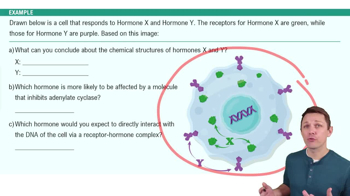
Intracellular Receptors and Direct Gene Action Example 1
5250
views
113
rank
5:13
Actions of Steroid Hormones
6400
views
157
rank
Terms in this set (15)
Hide definitions
Steroid Hormones
Lipid-soluble hormones that can pass through cell membranes to influence gene expression directly.
Amino Acid-Based Hormones
Hormones that cannot penetrate cell membranes and rely on second messenger systems.
Lipid Soluble
Characteristic of molecules that can dissolve in lipids, allowing them to pass through cell membranes.
Receptor Proteins
Proteins inside cells that bind to hormones to form a receptor-hormone complex.
Receptor-Hormone Complex
A complex formed when a hormone binds to its receptor, capable of influencing gene expression.
Cytoplasm
The part of the cell where receptor proteins may bind with hormones before entering the nucleus.
Nucleus
Cell organelle where the receptor-hormone complex binds to DNA to affect gene expression.
DNA Regions
Specific areas of DNA where the receptor-hormone complex binds to influence gene expression.
Gene Expression
The process by which information from a gene is used to synthesize RNA and proteins.
Direct Gene Action
Mechanism where hormones directly influence gene expression by binding to DNA.
Second Messenger Systems
Pathways used by amino acid-based hormones to transmit signals inside cells.
Transcription
The process of copying a segment of DNA into RNA, initiated by the receptor-hormone complex.
Protein Synthesis
The creation of proteins from RNA, a process influenced by steroid hormones.
Transport Protein
Proteins that bind to steroid hormones in the blood, aiding their transport to target cells.
Physiological Change
Alterations in body function or structure resulting from hormone-induced protein activity.
 BackBack

 2:39
2:39