Skip to main content
Anatomy & Physiology
My Course
Learn
Exam Prep
AI Tutor
Study Guides
Textbook Solutions
Flashcards
Explore
Try the app
My Course
Learn
Exam Prep
AI Tutor
Study Guides
Textbook Solutions
Flashcards
Explore
Try the app
Back
Introduction to Blood Vessels quiz #2
You can tap to flip the card.
Which vessels return oxygen-rich blood to the left atrium of the heart?
You can tap to flip the card.
👆
Which vessels return oxygen-rich blood to the left atrium of the heart?
The pulmonary veins return oxygen-rich blood to the left atrium of the heart.
Track progress
Control buttons has been changed to "navigation" mode.
1/20
Related flashcards
Related practice
Recommended videos
Introduction to Blood Vessels definitions
Introduction to Blood Vessels
15 Terms
Introduction to Blood Vessels quiz #1
Introduction to Blood Vessels
39 Terms
Introduction to Blood Vessels quiz #3
Introduction to Blood Vessels
14 Terms
Introduction to Blood Vessels
19. The Blood Vessels
4 problems
Topic
Jason
Types of Blood Vessels
19. The Blood Vessels
4 problems
Topic
Jason
19. The Blood Vessels - Part 1 of 2
4 topics
10 problems
Chapter
Jason
19. The Blood Vessels - Part 2 of 2
4 topics
9 problems
Chapter
Bruce
Guided course
3:38
Introduction to Blood Vessels Example 1
6636
views
132
rank
Guided course
4:59
Blood Vessels
9538
views
212
rank
2
comments
Guided course
2:04
Map of the Lesson on Blood Vessels
6790
views
212
rank
1
comments
Terms in this set (20)
Hide definitions
Which vessels return oxygen-rich blood to the left atrium of the heart?
The pulmonary veins return oxygen-rich blood to the left atrium of the heart.
What prevents the backflow of blood in veins?
Venous valves prevent the backflow of blood in veins.
Which blood vessel carries blood away from the heart?
Arteries carry blood away from the heart.
What blood vessels carry blood away from the heart?
Arteries carry blood away from the heart.
What is true regarding the arterial system?
The arterial system carries oxygenated blood away from the heart, except for the pulmonary arteries.
What vessels empty into the left atrium?
The pulmonary veins empty into the left atrium.
What are blood vessels and what is their primary function in the body?
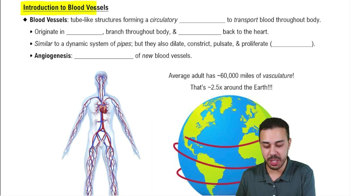
Blood vessels are tube-like structures that form a circulatory network, transporting blood throughout the body.
What role does the heart play in the circulatory network of blood vessels?
The heart acts as the pump that drives blood through the blood vessels, forming a complete circulatory network.
What is the difference between the blood vessels colored red and blue in diagrams?
Red vessels carry blood away from the heart to tissues, while blue vessels carry blood from tissues back to the heart.
What does it mean for a blood vessel to dilate or constrict?
Dilation is the enlargement of a vessel's diameter, while constriction is the narrowing of its diameter.
Approximately how many miles of blood vessels does the average adult have?
The average adult has about 60,000 miles of blood vessels.
What is the term for all the blood vessels in the body collectively?
The term for all the blood vessels in the body is 'vasculature.'
What are the three main types of blood vessels that will be discussed in detail?
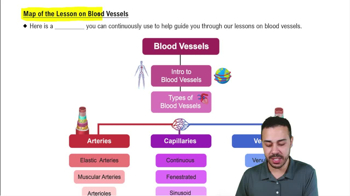
The three main types of blood vessels are arteries, capillaries, and veins.
What are the three types of capillaries that will be discussed?
The three types of capillaries are continuous capillaries, fenestrated capillaries, and sinusoid capillaries.
What are venules and how do they relate to veins?
Venules are small vessels that collect blood from capillaries and merge to form veins.
What are the three types of anastomoses that will be discussed?
The three types of anastomoses are arterial, venous, and arteriovenous anastomoses.
Why is the ability of blood vessels to pulsate important?
Pulsation allows blood vessels to accommodate changes in blood flow and pressure.
How does the circulatory network ensure efficient blood transport throughout the body?
The network branches extensively, reaching nearly all tissues and returning blood to the heart.
What is the function of veins in the circulatory system?
Veins carry blood from the tissues back to the heart.
What is the main topic that will be covered after the introduction to blood vessels?
The next topic will be the types of blood vessels: arteries, capillaries, and veins.
 BackBack

 3:38
3:38