Skip to main content
Anatomy & Physiology
My Course
Learn
Exam Prep
AI Tutor
Study Guides
Textbook Solutions
Flashcards
Explore
Try the app
My Course
Learn
Exam Prep
AI Tutor
Study Guides
Textbook Solutions
Flashcards
Explore
Try the app
Back
Introduction to Blood Vessels quiz #3
You can tap to flip the card.
Which areas of the body are considered avascular, and what does avascular mean?
You can tap to flip the card.
👆
Which areas of the body are considered avascular, and what does avascular mean?
Avascular areas, such as cartilages, tendons, and ligaments, lack blood vessels.
Track progress
Control buttons has been changed to "navigation" mode.
1/14
Related flashcards
Related practice
Recommended videos
Introduction to Blood Vessels definitions
Introduction to Blood Vessels
15 Terms
Introduction to Blood Vessels quiz #1
Introduction to Blood Vessels
39 Terms
Introduction to Blood Vessels quiz #2
Introduction to Blood Vessels
20 Terms
Introduction to Blood Vessels
19. The Blood Vessels
4 problems
Topic
Jason
Types of Blood Vessels
19. The Blood Vessels
4 problems
Topic
Jason
19. The Blood Vessels - Part 1 of 2
4 topics
10 problems
Chapter
Jason
19. The Blood Vessels - Part 2 of 2
4 topics
9 problems
Chapter
Bruce
Guided course
3:38
Introduction to Blood Vessels Example 1
6636
views
132
rank
Guided course
4:59
Blood Vessels
9538
views
212
rank
2
comments
Guided course
2:04
Map of the Lesson on Blood Vessels
6790
views
212
rank
1
comments
Terms in this set (14)
Hide definitions
Which areas of the body are considered avascular, and what does avascular mean?
Avascular areas, such as cartilages, tendons, and ligaments, lack blood vessels.
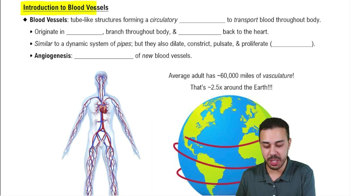
How do blood vessels form a circulatory network in the body?
Blood vessels originate and end at the heart, branching throughout the body and returning blood to the heart.
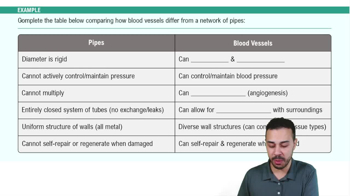
How are blood vessels similar to and different from household pipes?
Like pipes, blood vessels transport fluids, but unlike rigid pipes, blood vessels can dilate, constrict, pulsate, and proliferate.
What is angiogenesis and when does it occur?
Angiogenesis is the formation of new blood vessels, occurring during fetal development and throughout life.
How does the total length of blood vessels in an adult compare to the circumference of the Earth?
The total length of blood vessels in an adult could wrap around the Earth about 2.5 times.
Why is it important for avascular tissues to be near vascularized regions?
Avascular tissues rely on nearby vascularized regions to receive nutrients and oxygen by diffusion.
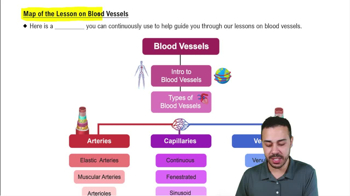
What are the three types of arteries that will be covered in future lessons?
The three types of arteries are elastic arteries, muscular arteries, and arterioles.
What is a capillary bed?
A capillary bed is a network of capillaries that supplies blood to a specific tissue or organ.
What is an anastomosis in the context of blood vessels?
An anastomosis is a merging point where two or more blood vessels connect.
How do blood vessels contribute to tissue repair and growth?
Blood vessels can proliferate and undergo angiogenesis to repair damage and form new vessels.
What is the significance of blood vessels being able to proliferate?
Proliferation enables blood vessels to replace or repair damaged vessels and support tissue growth.
What is the function of arteries in the circulatory system?
Arteries carry blood away from the heart to the tissues.
Why is it important for the circulatory network to begin and end at the heart?
This ensures continuous circulation and efficient delivery and removal of substances throughout the body.
How does angiogenesis benefit the body during a person's lifetime?
Angiogenesis ensures tissues receive adequate blood supply for growth, repair, and adaptation.
 BackBack

 3:38
3:38