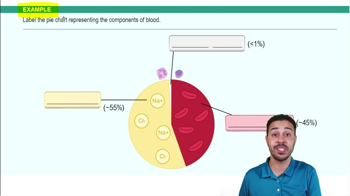
What percentage of blood is made up of plasma? a. 55% b. 40% c. 10% d. 5%
a. 55%
Which system creates blood cells? a. Nervous system b. Endocrine system c. Skeletal system d. Muscular system
c. Skeletal system
What are the four components of blood?
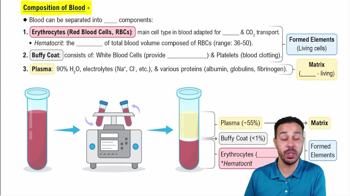
The four components of blood are plasma, red blood cells (erythrocytes), white blood cells (leukocytes), and platelets (thrombocytes).
What is not regulated by blood?
Hormone production
A client's blood glucose level is 45 mg/dL. The nurse should be alert for which signs and symptoms?
The nurse should be alert for signs and symptoms of hypoglycemia, such as confusion, dizziness, sweating, and weakness.
What are the formed elements?
The formed elements of blood include red blood cells, white blood cells, and platelets.
What are the formed elements of the blood?
The formed elements of the blood are erythrocytes (red blood cells), leukocytes (white blood cells), and thrombocytes (platelets).
Which term refers to the production of blood?
Hematopoiesis
What type of blood vessel helps return blood to the heart?
Veins
Which of these makes up the greatest portion of whole blood by volume? a. Red blood cells b. White blood cells c. Plasma d. Platelets
c. Plasma
What are the three primary types of plasma proteins?
The three primary types of plasma proteins are albumin, globulins, and fibrinogen.
In the countercurrent exchange system, blood flows how?
In the countercurrent exchange system, blood flows in opposite directions in adjacent vessels to maximize the exchange of substances.
What is hematopoiesis and where does it take place in the bones?
Hematopoiesis is the production of blood cells, and it takes place in the red bone marrow.
Which statements are true about neutrophils?
Neutrophils are a type of white blood cell that are the first responders to infection and are involved in the innate immune response.
What percentage of the blood is composed of plasma?
Approximately 55% of the blood is composed of plasma.
Plasma makes up approximately what percentage of whole blood?
Plasma makes up approximately 55% of whole blood.
Which of these might be part of an animal's circulatory system? a. Heart b. Lungs c. Liver d. Kidneys
a. Heart
Plasma makes up what percentage of the blood?
Plasma makes up about 55% of the blood.
Which of the formed elements arise from myeloid stem cells?
Red blood cells, platelets, and some types of white blood cells arise from myeloid stem cells.
What are the functions of blood?
The functions of blood include transport of gases, nutrients, and waste; regulation of body temperature and pH; and protection against blood loss and infection.
What is the function of blood?
The function of blood is to transport oxygen and nutrients to cells, remove waste products, regulate body temperature and pH, and protect against infection.
When a blood vessel is broken, what process occurs to prevent blood loss?
When a blood vessel is broken, the process of blood clotting occurs to prevent blood loss.
What is not a function of the blood?
Producing hormones
The client is to receive a unit of packed red blood cells. What is the nurse's first action?
The nurse's first action is to verify the client's identity and blood type to ensure compatibility.
What component makes up approximately 55% of blood by volume?
Plasma
One function of the spleen is to destroy worn-out red blood cells. What is the term for this?
The term for the destruction of worn-out red blood cells is hemolysis.
What are the formed elements of blood?
b. Red blood cells, c. White blood cells, d. Platelets
An individual with B antigens on their RBCs has which blood type?
An individual with B antigens on their RBCs has blood type B.
Which component of blood makes up 55 percent of the blood volume?
Plasma makes up 55 percent of the blood volume.
Where does blood cell production occur?
c. Red bone marrow
What are the functions of the blood?
The functions of the blood include transport of gases, nutrients, and waste; regulation of body temperature and pH; and protection against blood loss and infection.
What does a hematocrit measure?
A hematocrit measures the percentage of blood volume that is composed of red blood cells.
Which type of blood cells help fight infection?
White blood cells (leukocytes) help fight infection.
What are the disadvantages of using artificial blood?
Disadvantages of using artificial blood include limited oxygen-carrying capacity and potential for adverse reactions.
What percentage of blood is plasma?
Approximately 55% of blood is plasma.
What types of regulatory functions are performed by blood?
Blood performs regulatory functions such as maintaining body temperature, pH balance, and fluid volume.
What are the formed elements of blood?
The formed elements of blood are erythrocytes (red blood cells), leukocytes (white blood cells), and thrombocytes (platelets).
What is vascular spasm?
Vascular spasm is the immediate constriction of a blood vessel to reduce blood flow and limit blood loss after an injury.
 Back
Back
 2:36
2:36