Skip to main content
Anatomy & Physiology
My Course
Learn
Exam Prep
AI Tutor
Study Guides
Textbook Solutions
Flashcards
Explore
Try the app
My Course
Learn
Exam Prep
AI Tutor
Study Guides
Textbook Solutions
Flashcards
Explore
Try the app
Back
Introduction to Cellular Respiration definitions
You can tap to flip the card.
Aerobic Cellular Respiration
You can tap to flip the card.
👆
Aerobic Cellular Respiration
A process that breaks down glucose in the presence of oxygen to produce ATP, carbon dioxide, and water.
Track progress
Control buttons has been changed to "navigation" mode.
1/15
Related flashcards
Related practice
Recommended videos
Introduction to Cellular Respiration quiz
Introduction to Cellular Respiration
15 Terms
Introduction to Cellular Respiration
24. Metabolism and Nutrition
3 problems
Topic
24. Metabolism and Nutrition - Part 1 of 3
5 topics
9 problems
Chapter
24. Metabolism and Nutrition - Part 2 of 3
4 topics
5 problems
Chapter
24. Metabolism and Nutrition - Part 3 of 3
5 topics
8 problems
Chapter
Guided course
01:52
Introduction to Cellular Respiration Example 2
19396
views
229
rank
Guided course
04:18
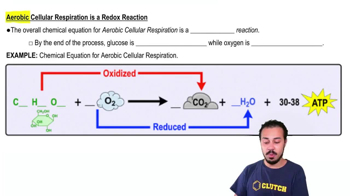
Aerobic Cellular Respiration is a Redox Reaction
29816
views
462
rank
Guided course
02:28
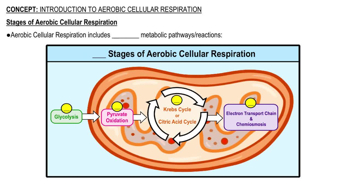
Stages of Aerobic Cellular Respiration
22854
views
351
rank
Terms in this set (15)
Hide definitions
Aerobic Cellular Respiration
A process that breaks down glucose in the presence of oxygen to produce ATP, carbon dioxide, and water.
ATP
The primary energy carrier in cells, produced in large amounts during aerobic cellular respiration.
Mitochondria
Organelles where most stages of aerobic cellular respiration occur, crucial for energy production.
Glycolysis
The first stage of cellular respiration, occurring in the cytoplasm, where glucose is broken down.
Pyruvate Oxidation
The second stage of cellular respiration, converting pyruvate into acetyl-CoA in the mitochondria.
Krebs Cycle
A series of reactions in the mitochondria that produce electron carriers for the electron transport chain.
Electron Transport Chain
A series of protein complexes in the mitochondria that generate ATP through oxidative phosphorylation.
Redox Reaction
A chemical reaction involving the transfer of electrons, crucial in cellular respiration.
Glucose
A monosaccharide sugar that is oxidized during cellular respiration to produce ATP.
Oxygen
The final electron acceptor in the electron transport chain, reduced to form water.
Carbon Dioxide
A byproduct of aerobic cellular respiration, released during the Krebs cycle.
Water
A byproduct of aerobic cellular respiration, formed when oxygen is reduced.
Substrate Level Phosphorylation
A method of ATP production occurring in glycolysis and the Krebs cycle.
Oxidative Phosphorylation
ATP production method in the electron transport chain, using energy from electron transfer.
Fermentation
An anaerobic process that allows glycolysis to continue by regenerating NAD+ in the absence of oxygen.
 BackBack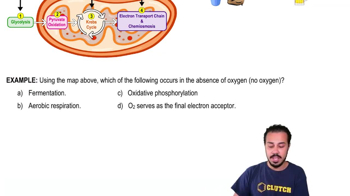
 01:52
01:52