Back

Introduction to T Lymphocytes quiz

Control buttons has been changed to "navigation" mode.
1/27
  • How do T cells coordinate the immune response?

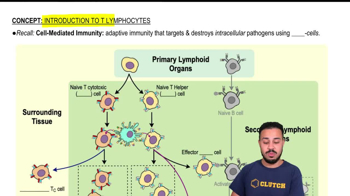
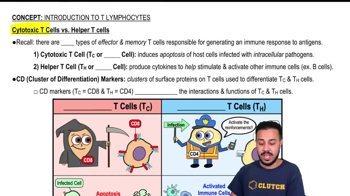
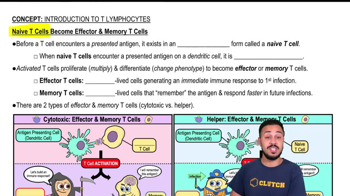
    T cells coordinate the immune response by recognizing specific antigens presented by antigen-presenting cells, leading to their activation. Helper T cells (CD4) produce cytokines to activate other immune cells, while cytotoxic T cells (CD8) induce apoptosis in infected cells.
  • What type of T cell can directly attack and kill other cells?

    Cytotoxic T cells (CD8 cells) can directly attack and kill other cells by inducing apoptosis in cells infected with intracellular pathogens.
  • Which T cells carry out attacks on foreign cells?

    Cytotoxic T cells (CD8 cells) carry out attacks on foreign cells by inducing apoptosis in infected host cells.
  • Where do T lymphocytes mature?

    T lymphocytes mature in the thymus.
  • Which receptor on the helper T-cell recognizes the specific antigen from an antigen-presenting cell?

    The T cell receptor (TCR) on the helper T-cell recognizes the specific antigen presented by an antigen-presenting cell.
  • What type of cells do cytotoxic T cells target?

    Virus-infected cells
  • The T lymphocytes mature in which organ?

    The T lymphocytes mature in the thymus.
  • What types of cells are most involved in the cell-mediated response?

    Cytotoxic T cells (CD8 cells) and helper T cells (CD4 cells) are most involved in the cell-mediated response.
  • What is the function of T cytotoxic cells?

    The function of T cytotoxic cells is to induce apoptosis in cells infected with intracellular pathogens.
  • Which T cell type is a component of both the cellular and humoral immune response?

    Helper T cells
  • To what do cytotoxic T cells bind with their T cell receptor (TCR)?

    Antigens presented on MHC I
  • What type of T cell is responsible for seeking out and destroying abnormal or infected cells?

    Cytotoxic T cells (CD8 cells) are responsible for seeking out and destroying abnormal or infected cells.
  • Which type of immunity mainly involves the action of T cells?

    Cell-mediated immunity mainly involves the action of T cells.
  • Which of the statements is true regarding T cell receptors? Select all that apply. A) They bind free antigens B) They consist of alpha and beta chains C) They recognize antigens presented by MHC molecules D) They are identical on a single T cell

    B) They consist of alpha and beta chains C) They recognize antigens presented by MHC molecules D) They are identical on a single T cell
  • The CD8 coreceptor is found on the surface of which cell type?

    The CD8 coreceptor is found on the surface of cytotoxic T cells.
  • On the surface of which cell type is the CD4 coreceptor found?

    The CD4 coreceptor is found on the surface of helper T cells.
  • What types of antigen do T cells not recognize?

    T cells do not recognize free antigens; they only recognize antigens presented by MHC molecules on antigen-presenting cells.
  • Which T cell plays an integral role in both humoral and cell-mediated immunity?

    Helper T cells (CD4 cells) play an integral role in both humoral and cell-mediated immunity.
  • What types of antigen are recognized by T cells?

    T cells recognize antigens that are presented by MHC molecules on the surface of antigen-presenting cells.
  • Which organ is responsible for T-lymphocyte maturation?

    Thymus
  • What does receptor editing of the T-cell receptor involve?

    It involves changes in the variable region
  • Which cells present processed antigens to T cells?

    All of the above
  • What is the function of cytotoxic T-cells?

    The function of cytotoxic T-cells is to induce apoptosis in cells infected with intracellular pathogens.
  • Which describes T cells? A) Part of the innate immune system B) Involved in humoral immunity C) Involved in cell-mediated immunity D) Mature in the bone marrow

    C) Involved in cell-mediated immunity
  • Which type of T cell recognizes antigens displayed on host cells with MHC II?

    Helper T cells
  • What organ develops T-cells during childhood?

    The thymus develops T-cells during childhood.
  • How do T and B lymphocytes recognize different antigens?

    T lymphocytes recognize antigens presented by MHC molecules on antigen-presenting cells, while B lymphocytes recognize free antigens directly through their B cell receptors.