Anatomy & Physiology
My Course
Learn
Exam Prep
AI Tutor
Study Guides
Textbook Solutions
Flashcards
Explore
My Course
Learn
Exam Prep
AI Tutor
Study Guides
Textbook Solutions
Flashcards
Explore
Back
Introduction to the Cytoskeleton definitions
You can tap to flip the card.
Cytoskeleton
You can tap to
flip the card.
👆
Cytoskeleton
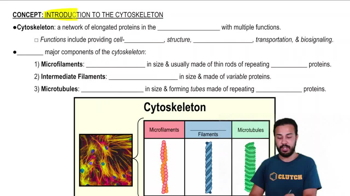
A network of elongated proteins in the cytoplasm providing cell shape, structure, movement, transportation, and biosignaling.
Track progress
Control buttons has been changed to "navigation" mode.
1/10
Related flashcards
Related practice
Recommended videos
Guided course
06:05
Introduction to the Cytoskeleton
Bruce Bryan
14265
views
178
rank
Guided course
03:14
Cilia & Flagella
Bruce Bryan
11601
views
121
rank
Terms in this set (10)
Hide definitions
Cytoskeleton
A network of elongated proteins in the cytoplasm providing cell shape, structure, movement, transportation, and biosignaling.
Microfilaments
The smallest cytoskeletal component, composed of thin rods of repeating actin proteins.
Intermediate filaments
Cytoskeletal components of intermediate size, made from various proteins, providing structural support.
Microtubules
The largest cytoskeletal component, forming large tubes from repeating tubulin proteins, crucial for cell movement.
Actin
A protein that forms thin rods, repeatedly assembling to create microfilaments in the cytoskeleton.
Tubulin
A protein that assembles into large tubes, forming microtubules, essential for cell structure and movement.
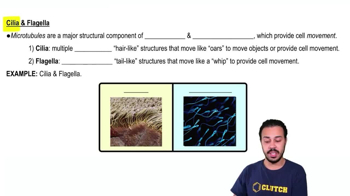
Cilia
Short, hair-like structures made of microtubules, moving like oars to propel cells or move objects.
Flagella
Long, tail-like structures made of microtubules, moving like whips to enable cell movement.
Fluorescence microscopy
A technique to visualize cytoskeletal components by coloring them, aiding in structural analysis.
Scanning electron micrograph
An imaging technique used to illustrate the structural differences and functions of cilia and flagella.