How do hormones contribute to the body's response to environmental changes?
Hormones help the body adapt by regulating physiological processes in response to changes such as stress, temperature, and nutrient availability.
What is the importance of hormone receptors in determining cellular response?
Only cells with the appropriate receptors can respond to a specific hormone, ensuring targeted effects.
How does the endocrine system achieve whole-body signaling?
By releasing hormones into the bloodstream, the endocrine system can send signals to virtually all parts of the body.
What is the main function of the pituitary gland?
The pituitary gland produces hormones that regulate other endocrine glands.
How do hormones regulate water balance in the body?
Hormones signal the kidneys to adjust urine output, maintaining proper water levels in the blood.
What is the role of the hypothalamus in hormone regulation?
The hypothalamus controls the release of hormones from the pituitary gland and helps maintain homeostasis.
How do hormones affect the immune system?
Hormones like those from the thymus help develop and regulate the immune system, especially in childhood.
What is the general effect of adrenaline on the body?
Adrenaline increases heart rate, blood flow, and energy availability during stress.
How do hormones regulate reproductive cycles?
Hormones control the timing and progression of reproductive cycles and processes.
What is the function of peptide hormones?
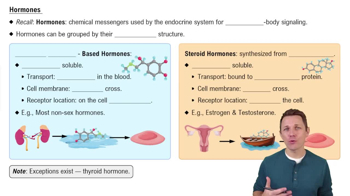
Peptide hormones act as chemical messengers, binding to cell membrane receptors to trigger cellular responses.
Why do some organs that release hormones not count as major endocrine glands?
If hormone release is not their main function, they are not considered major endocrine glands.
How does the endocrine system help coordinate growth?
Hormones regulate cell division, differentiation, and growth throughout development.
What is the main difference between endocrine and paracrine signaling?
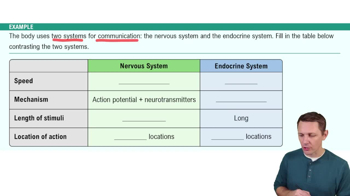
Endocrine signaling uses hormones that travel through the blood to distant targets, while paracrine signaling affects nearby cells within the same tissue.
What is the difference between endocrine and exocrine glands?
Endocrine glands secrete hormones directly into the blood for whole-body signaling, while exocrine glands secrete substances onto body surfaces or into body cavities.
What determines the specificity of hormone action in the body?
The specificity of hormone action derives from the presence of specific receptors on target cells that bind to particular hormones.
When blood calcium levels are low, what does parathyroid hormone (PTH) stimulate?
When blood calcium levels are low, parathyroid hormone stimulates target tissues to increase blood calcium levels, primarily by acting on bones, kidneys, and intestines.
Which hormone increases blood glucose levels?
Hormones such as glucagon and epinephrine increase blood glucose levels.
What is the primary function of the endocrine system?
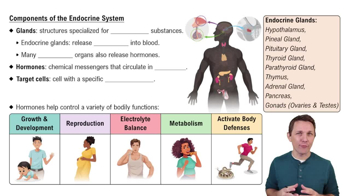
The endocrine system regulates bodily functions such as growth, metabolism, reproduction, stress response, and electrolyte balance through the release of hormones.
What primarily controls the secretion of parathyroid hormone?
The secretion of parathyroid hormone is primarily controlled by blood calcium levels.
Which hormone controls the milk let-down reflex?
Oxytocin controls the milk let-down reflex.
Is melatonin secreted by the adrenal cortex?
No, melatonin is secreted by the pineal gland, not the adrenal cortex.
Parathyroid hormone is antagonistic to which hormone?
Parathyroid hormone is antagonistic to calcitonin.
Which endocrine glands primarily control reproduction and fertility?
The gonads (ovaries in females and testes in males) primarily control reproduction and fertility.
Which gland among hypothalamus, pineal gland, sweat gland, and pancreas is not an endocrine gland?
The sweat gland is not an endocrine gland; it is an exocrine gland.
What is the main target tissue for parathyroid hormone?
The main target tissue for parathyroid hormone is bone, but it also acts on kidneys and intestines.
Which hormone is secreted by the pineal gland?
The pineal gland secretes melatonin.
Which endocrine gland secretes epinephrine?
The adrenal glands secrete epinephrine.
What hormone is secreted by the pineal gland?
Melatonin is secreted by the pineal gland.
Which endocrine gland produces insulin?
The pancreas produces insulin.
What is the difference between a hormone and a neurotransmitter?
Hormones are chemical messengers released into the blood for whole-body signaling, while neurotransmitters are released at synapses for localized signaling between nerve cells.
Which hormone is responsible for lowering blood glucose levels?
Insulin is responsible for lowering blood glucose levels.
Which endocrine gland secretes epinephrine?
The adrenal glands secrete epinephrine.
What is unique about the glands of the endocrine system?
Endocrine glands are unique because they release hormones directly into the blood, allowing for whole-body signaling.
What hormone is produced by the zona fasciculata of the adrenal cortex?
The zona fasciculata of the adrenal cortex produces cortisol.
 Back
Back

 7:06
7:06