Skip to main content
Anatomy & Physiology
My Course
Learn
Exam Prep
AI Tutor
Study Guides
Textbook Solutions
Flashcards
Explore
Try the app
My Course
Learn
Exam Prep
AI Tutor
Study Guides
Textbook Solutions
Flashcards
Explore
Try the app
Back
Introduction to the Lymphatic System definitions
5 students found this helpful
You can tap to flip the card.
Lymphatic System
You can tap to flip the card.
👆
Lymphatic System
A network of vessels and organs that maintain fluid balance and aid immunity, addressing cardiovascular system limitations.
Track progress
Control buttons has been changed to "navigation" mode.
1/15
Related flashcards
Related practice
Recommended videos
Introduction to the Lymphatic System quiz #1
Introduction to the Lymphatic System
37 Terms
Introduction to the Lymphatic System quiz #2
Introduction to the Lymphatic System
17 Terms
Introduction to the Lymphatic System quiz #3
Introduction to the Lymphatic System
11 Terms
Introduction to the Lymphatic System
20. The Lymphatic System
4 problems
Topic
Lymphatic Vasculature
20. The Lymphatic System
4 problems
Topic
Jason
20. The Lymphatic System - Part 1 of 2
4 topics
9 problems
Chapter
Jason
20. The Lymphatic System - Part 2 of 2
4 topics
9 problems
Chapter
Bruce
Guided course
3:32
Introduction to the Lymphatic System Example 2
4958
views
92
rank
Guided course
3:33
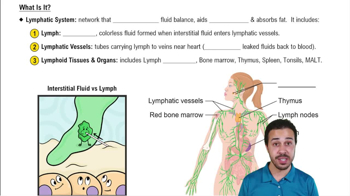
What Is It?
6629
views
174
rank
Guided course
3:57
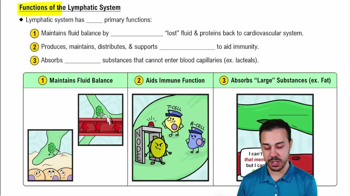
Functions of the Lymphatic System
5606
views
131
rank
Terms in this set (15)
Hide definitions
Lymphatic System
A network of vessels and organs that maintain fluid balance and aid immunity, addressing cardiovascular system limitations.
Lymph
Clear fluid formed when interstitial fluid enters lymphatic vessels, differing mainly by location.
Lymphatic Vessels
Tube-like structures carrying lymph to veins near the heart, returning leaked fluids and proteins.
Lymphoid Organs
Structures like lymph nodes, thymus, and spleen involved in immune response and lymphocyte production.
Interstitial Fluid
Fluid surrounding tissue cells, becoming lymph when entering lymphatic vessels.
Lymphocytes
White blood cells, including B cells and T cells, crucial for immune response.
Lacteals
Specialized lymphatic capillaries in the small intestine that absorb dietary fats and lipid-soluble vitamins.
Thymus
Lymphoid organ where T cells mature, playing a role in immune function.
Spleen
Organ involved in filtering blood, recycling red blood cells, and housing lymphocytes.
Tonsils
Lymphoid tissues located in the throat, involved in trapping pathogens entering through the mouth or nose.
MALT
Mucosal associated lymphoid tissues that protect mucosal surfaces from pathogens.
Bone Marrow
Primary lymphoid organ where blood cells, including lymphocytes, are produced.
Fluid Balance
Maintenance of fluid levels in the body by returning leaked fluids to the cardiovascular system.
Immune Interactions
Processes involving lymphocytes and pathogens, optimized by the lymphatic system.
Macromolecules
Large molecules like fats, absorbed by the lymphatic system, not effectively by the cardiovascular system.
 BackBack

 3:32
3:32