Pearson+ LogoPearson+ Logo
Back

Introduction to the Peripheral Nervous System quiz #1

Control buttons has been changed to "navigation" mode.
1/26
  • What structures are included in the peripheral nervous system (PNS), and how does it differ from the central nervous system (CNS)?

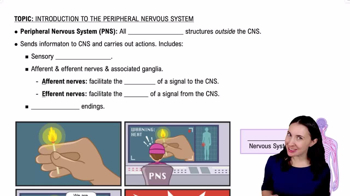
    The PNS includes all neural structures outside the CNS, such as sensory receptors, afferent and efferent nerves, associated ganglia, and motor endings. Unlike the CNS, which consists of the brain and spinal cord, the PNS connects the CNS to the rest of the body and carries out its commands.
  • How do afferent and efferent nerves function within the peripheral nervous system?

    Afferent nerves carry sensory information from the body to the CNS (arrival), while efferent nerves transmit commands from the CNS to the body (exit), enabling responses such as movement.
  • Describe the relationship between the central nervous system (CNS) and the peripheral nervous system (PNS) using the example of touching something hot.

    When you touch something hot, sensory receptors in your skin detect the heat and send signals via afferent nerves to the CNS. The CNS processes this information and sends commands back through efferent nerves in the PNS, causing you to move your hand away.
  • What are the main components of the peripheral nervous system (PNS)?

    The PNS is made up of sensory receptors, afferent and efferent nerves, associated ganglia, and motor endings.
  • How does the PNS differ from the central nervous system (CNS)?

    The PNS includes all neural structures outside the brain and spinal cord, while the CNS consists only of the brain and spinal cord.
  • What is the function of afferent nerves in the PNS?

    Afferent nerves carry sensory information from the body to the CNS, facilitating the arrival of signals.
  • What is the role of efferent nerves in the PNS?

    Efferent nerves transmit commands from the CNS to the body, facilitating the exit of signals to carry out actions.
  • What are ganglia in the context of the PNS?

    Ganglia are clusters of neuron cell bodies located outside the CNS, within the PNS.
  • Describe the process that occurs when you touch something hot, involving both the CNS and PNS.

    Sensory receptors in your skin detect heat and send signals via afferent nerves to the CNS, which then sends commands back through efferent nerves in the PNS to move your hand away.
  • How does the PNS help us interact with our environment?

    The PNS makes us aware of the world around us by sending sensory information to the CNS and carrying out the CNS's commands to respond to stimuli.
  • What structures make up the peripheral nervous system (PNS)?

    The peripheral nervous system consists of sensory receptors, afferent and efferent nerves, associated ganglia, and motor endings.
  • Which components are included in the peripheral nervous system?

    The peripheral nervous system includes sensory receptors, afferent and efferent nerves, ganglia, and motor endings.
  • What is the primary function of the peripheral nervous system?

    The primary function of the peripheral nervous system is to make us aware of the world around us and help us navigate it by sending information to the central nervous system and carrying out its commands.
  • Which type of neurons initiate muscle contraction and activate glands in the peripheral nervous system?

    Efferent neurons initiate muscle contraction and activate glands by carrying signals from the central nervous system to the peripheral nervous system.
  • What is included in the peripheral nervous system?

    The peripheral nervous system includes all neural structures outside the brain and spinal cord: sensory receptors, afferent and efferent nerves, ganglia, and motor endings.
  • The peripheral nervous system is composed of which main elements?

    The peripheral nervous system is composed of sensory receptors, afferent and efferent nerves, ganglia, and motor endings.
  • What does the peripheral nervous system include?

    The peripheral nervous system includes sensory receptors, afferent and efferent nerves, ganglia, and motor endings.
  • What is the main function of the peripheral nervous system?

    The main function of the peripheral nervous system is to send sensory information to the central nervous system and carry out its commands, making us aware of and able to respond to our environment.
  • What is the somatic nervous system responsible for?

    The somatic nervous system is responsible for controlling voluntary actions, such as movement of skeletal muscles.
  • What does the peripheral nervous system consist of?

    The peripheral nervous system consists of sensory receptors, afferent and efferent nerves, ganglia, and motor endings.
  • Which nervous system controls skeletal muscles?

    The somatic nervous system, a part of the peripheral nervous system, controls skeletal muscles.
  • Which nervous system is responsible for voluntary actions?

    The somatic nervous system is responsible for voluntary actions.
  • What does the somatic nervous system manage?

    The somatic nervous system manages voluntary movements by controlling skeletal muscles.
  • What is the job of the peripheral nervous system?

    The job of the peripheral nervous system is to relay sensory information to the central nervous system and carry out its commands, enabling awareness and response to the environment.
  • What is the function of the peripheral nervous system?

    The function of the peripheral nervous system is to transmit sensory information to the central nervous system and execute its commands, allowing us to perceive and interact with our surroundings.
  • How do afferent and efferent nerves differ in the peripheral nervous system?

    Afferent nerves carry signals to the central nervous system (arrival), while efferent nerves carry signals away from the central nervous system to the peripheral nervous system (exit).