During which stage of the ovarian cycle will LH spike?
LH spikes during the ovulation stage of the ovarian cycle.
What is considered the mature ovary structure?
Graafian follicle.
During the phallic stage, what occurs?
The phallic stage is a psychosexual development stage in children, not directly related to reproductive anatomy.
In which structure do sperm cells develop to maturity?
Sperm cells develop to maturity in the epididymis.
How much of the seminal fluid in the ejaculation does the prostate gland secrete?
The prostate gland secretes about 30% of the seminal fluid in ejaculation.
During menses, what occurs?
During menses, the functional layer of the endometrium is shed, resulting in menstrual bleeding.
What is the entire process of sperm production called?
The entire process of sperm production is called spermatogenesis.
Which structures produce ova and the hormones estrogen and progesterone?
The ovaries produce ova and the hormones estrogen and progesterone.
Which organs do not contribute to semen production?
Ovaries.
What occurs during the follicular phase of the menstrual cycle?
The follicular phase involves the development of follicles.
What is the role of the clitoris in the reproductive system?
The clitoris is involved in sexual arousal.
Which reproductive method is the most prevalent in mammals?
Internal fertilization is the most prevalent reproductive method in mammals.
What is the term that best describes egg and sperm?
The term that best describes egg and sperm is gametes.
Following ovulation, what occurs?
Following ovulation, the corpus luteum forms and secretes progesterone to maintain the endometrium.
What is the function of the sperm cell's acrosome?
The acrosome contains enzymes that help the sperm penetrate the egg during fertilization.
At what stage does oogenesis begin?
B) Oogenesis begins at puberty.
Which is an example of a secondary sex characteristic? A) Facial hair in males. B) Ovaries in females. C) Testes in males. D) Uterus in females.
A) Facial hair in males.
How are a vasectomy and a tubal ligation similar?
Both a vasectomy and a tubal ligation are surgical procedures that prevent the passage of gametes, thus serving as permanent birth control methods.
What is a true statement about oral contraceptives regarding their usage?
B) Oral contraceptives require daily intake.
What is a true statement about the reproductive system of human females?
C) Females undergo menopause.
When do the oogonia undergo mitosis?
Oogonia undergo mitosis during fetal development.
What is an example of a secondary sex characteristic?
An example of a secondary sex characteristic is breast development in females.
What is an example of a secondary sexual characteristic?
A) Deepening of voice in males.
The ovary develops into what structure?
The ovary develops follicles, which can mature into ova.
In which structure does oogenesis occur?
Oogenesis occurs in the ovaries.
What is the function of the clitellum?
The clitellum is not related to human reproduction; it is part of the reproductive system in annelids like earthworms.
What part of the reproductive cycle is a virulent virus in?
A virulent virus is not part of the reproductive cycle; it refers to the ability of a virus to cause disease.
What is the function of the ductus deferens?
The ductus deferens transports sperm from the epididymis to the ejaculatory duct.
What is the function of the seminiferous tubules?
The seminiferous tubules are the site of sperm production in the testes.
What are the primary sex organs in males and females, and what are their main functions?
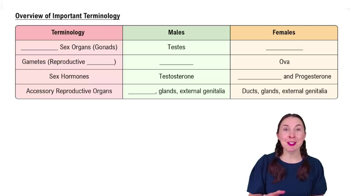
The primary sex organs are the testes in males and the ovaries in females. Their main functions are to produce sex hormones and gametes (sperm in males, ova in females).
Which hormones are considered the primary sex hormones in males and females?
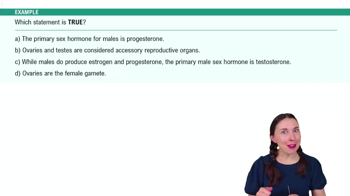
Testosterone is the primary sex hormone in males, while estrogen and progesterone are the primary sex hormones in females.
What are accessory reproductive organs, and what are some examples?
Accessory reproductive organs include ducts, glands, and external genitalia, which are essential for reproductive functions in both males and females.
List the four major functions of the reproductive system.
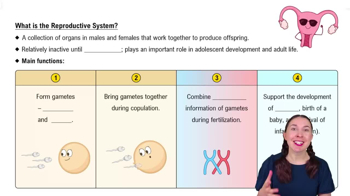
The four major functions are: forming gametes, bringing gametes together during copulation, combining genetic information during fertilization, and (in females) supporting fetus development and infant survival through lactation.
What is the role of sex hormones in the reproductive system?
Sex hormones assist in the maturation and function of reproductive organs and have various other roles throughout the body.
What is the function of the ovaries?
The ovaries produce ova (eggs) and secrete estrogen and progesterone.
What is fertilization, and why is it important?
Fertilization is the process of combining genetic information from male and female gametes, resulting in the formation of a zygote.
What is the main function of ducts in the reproductive system?
Ducts transport gametes and secretions within the reproductive system.
 Back
Back
 2:08
2:08