Krebs Cycle definitions Flashcards

Krebs Cycle definitions
Control buttons has been changed to "navigation" mode.
1/15
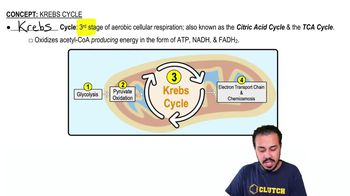
  • Krebs Cycle
    The third stage of aerobic respiration, oxidizing acetyl-CoA to produce ATP, NADH, and FADH2.
  • Citric Acid Cycle
    Another name for the Krebs Cycle, emphasizing the production of citrate from acetyl-CoA and oxaloacetate.
  • TCA Cycle
    A synonym for the Krebs Cycle, highlighting its role in tricarboxylic acid metabolism.
  • Acetyl-CoA
    A molecule that enters the Krebs Cycle, reacting with oxaloacetate to form citrate.
  • Oxaloacetate
    A four-carbon molecule that reacts with acetyl-CoA to form citrate in the Krebs Cycle.
  • Citrate
    A six-carbon molecule formed in the Krebs Cycle from acetyl-CoA and oxaloacetate.
  • NADH
    An electron carrier produced in the Krebs Cycle, used in the electron transport chain.
  • FADH2
    An electron carrier produced in the Krebs Cycle, contributing to ATP production in the ETC.
  • ATP
    The primary energy currency of the cell, produced in small amounts during the Krebs Cycle.
  • CO2
    A byproduct of the Krebs Cycle, released during the oxidation of citrate.
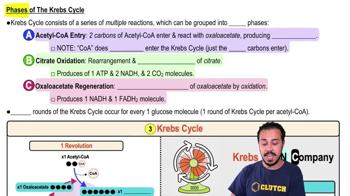
  • Phase A
    The initial phase of the Krebs Cycle where acetyl-CoA enters and forms citrate.
  • Phase B
    The phase of the Krebs Cycle involving citrate oxidation, producing ATP, NADH, and CO2.
  • Phase C
    The final phase of the Krebs Cycle, regenerating oxaloacetate and producing NADH and FADH2.
  • Substrate-level Phosphorylation
    A process in the Krebs Cycle that generates ATP directly from a substrate.
  • Electron Transport Chain
    The final stage of aerobic respiration where NADH and FADH2 are used to produce ATP.