Control buttons has been changed to "navigation" mode.
1/10
Terms in this set (10)
What is the approximate partial pressure of oxygen in arterial blood at sea level, and how is it calculated?
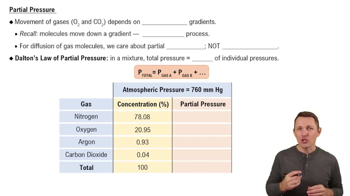
At sea level, the partial pressure of oxygen in arterial blood is approximately 160 mmHg. It is calculated using Dalton's law by multiplying the percent composition of oxygen in atmospheric air (about 21%) by the total atmospheric pressure (760 mmHg): 0.21 × 760 mmHg ≈ 160 mmHg.
What is the main factor that determines the movement of oxygen and carbon dioxide during respiration?
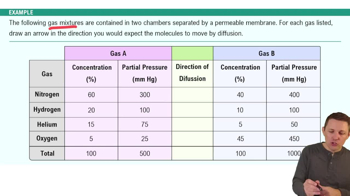
The main factor is the pressure gradient of each gas. Molecules move passively down their pressure gradients without requiring cellular energy.
Why do we use partial pressure instead of concentration when discussing gas diffusion in respiration?
Partial pressure is used because it directly determines the movement of gas molecules across membranes. Concentration is less relevant for gases in mixtures like air.
How is the partial pressure of nitrogen in atmospheric air calculated at sea level?
Multiply the percent composition of nitrogen (about 78%) by the total atmospheric pressure (760 mmHg). This gives a partial pressure of approximately 593.4 mmHg.
What happens to the partial pressure of oxygen when atmospheric pressure decreases at higher altitudes?
The partial pressure of oxygen decreases because it is calculated as a percentage of the lower total atmospheric pressure. This results in less oxygen available for diffusion into the blood.
How does Henry's law relate to the amount of gas dissolved in a liquid?
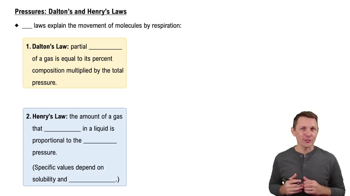
Henry's law states that the amount of gas that dissolves in a liquid is proportional to its partial pressure. This means higher partial pressure leads to more gas dissolving.
What two additional factors, besides partial pressure, influence how much gas dissolves in a liquid according to Henry's law?
Solubility of the gas and temperature also affect how much gas dissolves. However, temperature is usually constant in the human body due to homeostasis.
Why might someone feel lightheaded at high altitude even though the percentage of oxygen in the air remains the same?
At high altitude, the total atmospheric pressure is lower, so the partial pressure of oxygen is also lower. This means less oxygen dissolves in the blood, leading to symptoms like lightheadedness.
What mnemonic can help you remember the difference between Dalton's and Henry's laws?
The mnemonic is 'Dalton divides the pressure, Henry hydrates it.' This means Dalton's law splits total pressure into partial pressures, while Henry's law relates partial pressure to gas dissolving in liquid.
Why is temperature not a significant variable for Henry's law in human physiology?
Temperature is not significant because the human body maintains a constant internal temperature through homeostasis. This allows us to focus mainly on partial pressure and solubility for gas exchange.