Skip to main content
Anatomy & Physiology
My Course
Learn
Exam Prep
AI Tutor
Study Guides
Textbook Solutions
Flashcards
Explore
Try the app
My Course
Learn
Exam Prep
AI Tutor
Study Guides
Textbook Solutions
Flashcards
Explore
Try the app
Back
Leukocytes definitions
1 student found this helpful
You can tap to flip the card.
Leukocytes
You can tap to flip the card.
👆
Leukocytes
Cells crucial for immunity, also known as white blood cells, that defend against pathogens.
Track progress
Control buttons has been changed to "navigation" mode.
1/15
Related flashcards
Related practice
Recommended videos
Leukocytes quiz
Leukocytes
8 Terms
Leukocytes quiz #1
Leukocytes
10 Terms
Leukocytes
17. The Blood
7 problems
Topic
Jason
Platelets: Hemostasis
17. The Blood
7 problems
Topic
Jason
17. The Blood
5 topics
12 problems
Chapter
Jason
Guided course
3:26
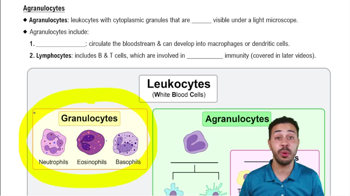
Agranulocytes
6624
views
122
rank
Guided course
2:33
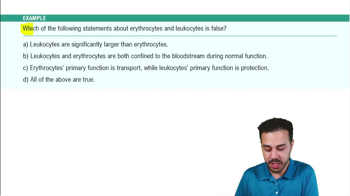
Leukocytes Example 1
7265
views
136
rank
Guided course
3:08
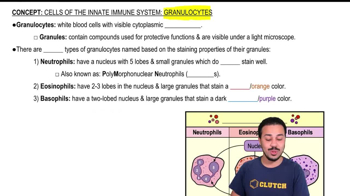
Granulocytes
7415
views
157
rank
Terms in this set (15)
Hide definitions
Leukocytes
Cells crucial for immunity, also known as white blood cells, that defend against pathogens.
Granulocytes
White blood cells with visible cytoplasmic granules, including neutrophils, eosinophils, and basophils.
Agranulocytes
White blood cells without visible cytoplasmic granules, including monocytes and lymphocytes.
Neutrophils
Most abundant leukocytes, first responders to infection, capable of phagocytosis and degranulation.
Eosinophils
Granulocytes involved in combating parasitic infections and allergic reactions.
Basophils
Granulocytes that release histamine, playing a role in allergic reactions and inflammation.
Monocytes
Agranulocytes that can differentiate into macrophages or dendritic cells, key in phagocytosis.
Lymphocytes
Agranulocytes involved in adaptive immunity, including B cells, T cells, and NK cells.
Macrophages
Phagocytic cells derived from monocytes, acting as sentinel cells in tissues.
Dendritic cells
Sentinel cells that present antigens to activate adaptive immune responses.
B cells
Lymphocytes that produce antibodies as part of the adaptive immune response.
T cells
Lymphocytes that mediate cellular immunity, recognizing specific antigens.
Natural Killer cells
Innate lymphoid cells that kill a variety of infected or cancerous cells.
Histamine
A molecule released by basophils and mast cells, increasing capillary permeability during inflammation.
Phagocytosis
The process by which cells ingest and digest foreign particles or microbes.
 BackBack
 3:26
3:26