Skip to main content
Anatomy & Physiology
My Course
Learn
Exam Prep
AI Tutor
Study Guides
Textbook Solutions
Flashcards
Explore
Try the app
My Course
Learn
Exam Prep
AI Tutor
Study Guides
Textbook Solutions
Flashcards
Explore
Try the app
Back
Leukocytes quiz
You can tap to flip the card.
Leukocytes can undergo diapedesis. What is diapedesis?
You can tap to flip the card.
👆
Leukocytes can undergo diapedesis. What is diapedesis?
Diapedesis is the process by which leukocytes migrate out of the bloodstream into surrounding tissues to perform their functions.
Track progress
Control buttons has been changed to "navigation" mode.
1/8
Related flashcards
Related practice
Recommended videos
Leukocytes definitions
Leukocytes
15 Terms
Leukocytes quiz #1
Leukocytes
10 Terms
Leukocytes
17. The Blood
7 problems
Topic
Jason
Platelets: Hemostasis
17. The Blood
7 problems
Topic
Jason
17. The Blood
5 topics
12 problems
Chapter
Jason
Guided course
3:26
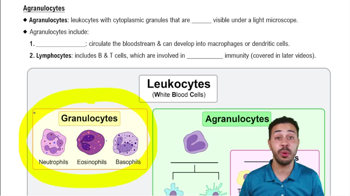
Agranulocytes
6620
views
122
rank
Guided course
2:33
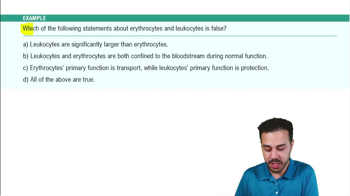
Leukocytes Example 1
7257
views
136
rank
Guided course
3:08
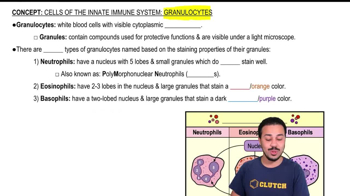
Granulocytes
7408
views
157
rank
Terms in this set (8)
Hide definitions
Leukocytes can undergo diapedesis. What is diapedesis?
Diapedesis is the process by which leukocytes migrate out of the bloodstream into surrounding tissues to perform their functions.
Which leukocyte increases in number during parasitic infections?
Eosinophils increase in number during parasitic infections.
What is the most common type of leukocyte in a healthy adult?
Neutrophils are the most common type of leukocyte in a healthy adult.
Which type of leukocyte releases histamine?
Basophils release histamine to increase capillary permeability and facilitate immune response.
What are the two major groups of leukocytes based on their appearance under a microscope?
The two major groups of leukocytes are granulocytes and agranulocytes.
What is the primary role of eosinophils?
The primary role of eosinophils is to protect against parasitic worms and they are also involved in allergic reactions.
What is the function of neutrophil extracellular traps (NETs)?
NETs act as webs of chromatin to trap and immobilize microbes, aiding in their destruction.
What is the role of monocytes in the immune system?
Monocytes can differentiate into macrophages or dendritic cells, which are key in phagocytosis and initiating immune responses.
 BackBack
 3:26
3:26