Which types of white blood cells (leukocytes) are capable of phagocytosis?
Neutrophils, monocytes (which differentiate into macrophages and dendritic cells), macrophages, and dendritic cells are white blood cells capable of phagocytosis.
What is the main function of white blood cells (leukocytes) in the body?
The main function of white blood cells is to provide immunity by defending the body against pathogens and foreign substances through various mechanisms such as phagocytosis, production of antimicrobial substances, and coordination of immune responses.
What distinguishes granulocytes from agranulocytes under a light microscope after staining?
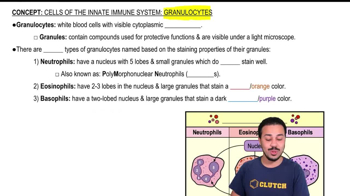
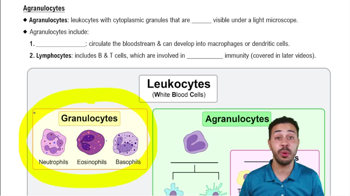
Granulocytes have cytoplasmic granules that are easily visible under a light microscope after staining, while agranulocytes do not have easily visible granules. Both types may contain granules, but only those in granulocytes are readily observed.
Which leukocyte is the most abundant in the blood and what percentage can it comprise?
Neutrophils are the most abundant leukocyte in the blood, making up to 70% of all leukocytes. This makes them the primary responders to infection or tissue damage.
What is the main function of neutrophil extracellular traps (NETs)?
NETs are webs of chromatin released by neutrophils to trap infecting microbes. This trapping mechanism helps immobilize and contain pathogens at the site of infection.
How do eosinophils contribute to the body's defense against parasitic worms?
Eosinophils contain granules with antimicrobial substances and enzymes that disrupt the membrane permeability of parasitic worms. These actions help destroy and kill the parasites.
What role does histamine released by basophils play during inflammation?
Histamine increases capillary permeability, allowing other defense cells to leave the bloodstream and enter infected tissues. This promotes inflammation and enhances the immune response.
How do resident macrophages differ from wandering macrophages in their location and function?
Resident macrophages remain stationary in specific tissues and are always present to respond to infection, while wandering macrophages circulate in the blood and can be recruited to sites of infection. Both types are derived from monocytes.
What is the primary function of dendritic cells in the immune system?
Dendritic cells act as sentinel cells that detect microbes, ingest and process antigens, and present them to adaptive immune cells. This process helps activate B cells and T cells for adaptive immunity.
How do natural killer (NK) cells differ from B cells and T cells in terms of antigen specificity?
Natural killer cells lack antigen specificity and are part of innate immunity, targeting a variety of cell types. In contrast, B cells and T cells are highly specific and function in adaptive immunity.
 Back
Back
 3:26
3:26