Skip to main content
Anatomy & Physiology
My Course
Learn
Exam Prep
AI Tutor
Study Guides
Textbook Solutions
Flashcards
Explore
Try the app
My Course
Learn
Exam Prep
AI Tutor
Study Guides
Textbook Solutions
Flashcards
Explore
Try the app
Back
Lymphoid Cells & Tissues definitions
3 students found this helpful
You can tap to flip the card.
Lymphocytes
You can tap to flip the card.
👆
Lymphocytes
White blood cells including T cells, B cells, and NK cells, crucial for adaptive and innate immunity.
Track progress
Control buttons has been changed to "navigation" mode.
1/15
Related flashcards
Related practice
Recommended videos
Lymphoid Cells & Tissues quiz
Lymphoid Cells & Tissues
10 Terms
Lymphoid Cells & Tissues
20. The Lymphatic System
5 problems
Topic
Jason
Overview of Lymphoid Organs
20. The Lymphatic System
4 problems
Topic
20. The Lymphatic System - Part 1 of 2
4 topics
9 problems
Chapter
Jason
20. The Lymphatic System - Part 2 of 2
4 topics
9 problems
Chapter
Bruce
Guided course
1:48
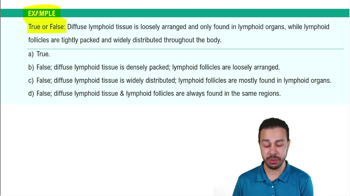
Lymphoid Cells & Tissues Example 2
3095
views
63
rank
Guided course
4:55
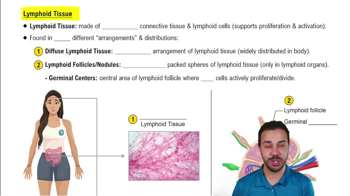
Lymphoid Tissue
3736
views
80
rank
1
comments
Guided course
1:35
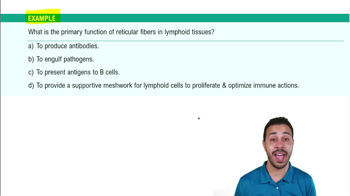
Lymphoid Cells & Tissues Example 1
3400
views
70
rank
Terms in this set (15)
Hide definitions
Lymphocytes
White blood cells including T cells, B cells, and NK cells, crucial for adaptive and innate immunity.
Macrophages
White blood cells specialized in phagocytosis, ingesting and breaking down foreign material.
Dendritic cells
White blood cells that capture antigens and present them to activate other immune cells.
Reticular cells
Cells that produce reticular fibers, forming a supportive network in lymphoid tissues.
Reticular connective tissue
A type of loose connective tissue with net-like reticular fibers in its extracellular matrix.
Diffuse lymphoid tissue
Lymphoid tissue with a loose arrangement, widely distributed in the body.
Lymphoid follicles
Densely packed spheres of lymphoid tissue found in lymphoid organs, often with germinal centers.
Germinal centers
Central areas in lymphoid follicles where B cells actively proliferate and divide.
Lymphoid organs
Structures containing lymphoid tissue, such as lymph nodes, but excluding the thymus.
Thymus
An organ specific to T cell development, lacking lymphoid follicles and B cells.
Adaptive immunity
Immune response involving lymphocytes like T and B cells, tailored to specific pathogens.
Innate immunity
Non-specific immune response involving cells like NK cells, providing immediate defense.
Phagocytosis
Process by which cells ingest and break down foreign material.
Antigens
Substances that trigger an immune response, often captured by dendritic cells.
Reticular fibers
Net-like or branched fibers forming a supportive network in lymphoid tissues.
 BackBack

 1:48
1:48