Anatomy & Physiology
My Courses
College Courses
My Courses
Chemistry
General Chemistry
Organic Chemistry
Analytical Chemistry
GOB Chemistry
Biochemistry
Intro to Chemistry
Biology
General Biology
Microbiology
Anatomy & Physiology
Genetics
Cell Biology
Physics
Physics
Math
College Algebra
Trigonometry
Precalculus
Calculus
Business Calculus
Statistics
Business Statistics
Social Sciences
Psychology
Health Sciences
Personal Health
Nutrition
Business
Microeconomics
Macroeconomics
Financial Accounting
Calculators
AI Tools
Study Prep Blog
Study Prep Home
My Course
Learn
Exam Prep
AI Tutor
Study Guides
Textbook Solutions
Flashcards
Explore
Try the app
My Course
Learn
Exam Prep
AI Tutor
Study Guides
Textbook Solutions
Flashcards
Explore
Try the app
Osmosis quiz Flashcards
Back
Osmosis quiz
You can tap to flip the card.
Crenation can result from a change in which of the following: hypotonic, isotonic, or hypertonic solutions?
You can tap to
flip the card.
👆
Crenation can result from a change in which of the following: hypotonic, isotonic, or hypertonic solutions?
Crenation occurs in hypertonic solutions where cells lose water and shrink.
Track progress
Control buttons has been changed to "navigation" mode.
1/10
Related flashcards
Related practice
Recommended videos
Guided course
05:59
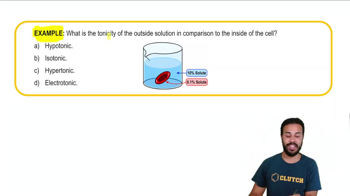
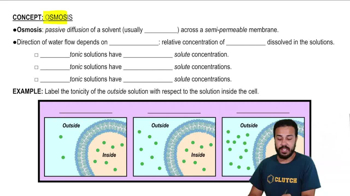
Osmosis
Bruce Bryan
17666
views
326
rank
Guided course
02:18
Osmosis Example 1
Bruce Bryan
12781
views
234
rank
Guided course
06:48
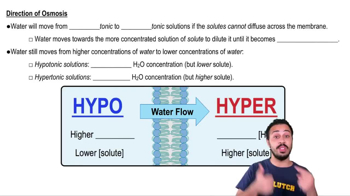
Direction of Osmosis
Bruce Bryan
14240
views
234
rank
Terms in this set (10)
Hide definitions
Crenation can result from a change in which of the following: hypotonic, isotonic, or hypertonic solutions?
Crenation occurs in hypertonic solutions where cells lose water and shrink.
What type of solution is perfect for animal cells: hypotonic, isotonic, or hypertonic?
Animal cells prefer isotonic solutions to maintain their size and avoid lysis or dehydration.
Plasma oncotic pressure is created by the movement of which of the following: water, solutes, or proteins?
Plasma oncotic pressure is primarily created by proteins, particularly albumin, in the blood.
What is the osmolarity of the filtrate at the end of the proximal tubule?
The osmolarity of the filtrate at the end of the proximal tubule is typically isotonic to plasma.
Why is excretion important in order to achieve osmotic balance?
Excretion helps remove excess solutes and water, maintaining osmotic balance and preventing cell damage.
Which of the following are strategies that organisms use to maintain osmotic balance: osmoregulation, diffusion, or active transport?
Organisms use osmoregulation and active transport to maintain osmotic balance.
What type of solution is typically preferred in animals: hypotonic, isotonic, or hypertonic?
Animals typically prefer isotonic solutions to maintain cellular homeostasis.
What happens when body cells are placed in a hypertonic solution?
In a hypertonic solution, body cells lose water and shrink, leading to dehydration.
What percentage of water was absorbed?
The percentage of water absorbed depends on the specific context and conditions, such as the type of solution and cell type.
How does water move during osmosis in terms of solute concentration?
During osmosis, water moves from areas of lower solute concentration (hypotonic) to areas of higher solute concentration (hypertonic).