Pearson+ LogoPearson+ Logo

Osmosis quiz #1 Flashcards

Back
Osmosis quiz #1
Control buttons has been changed to "navigation" mode.
1/14
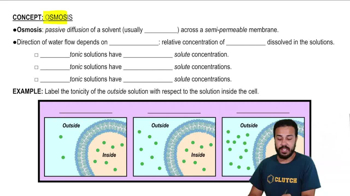
  • What is osmosis, and how does the direction of water movement relate to the tonicity of solutions on either side of a semipermeable membrane?

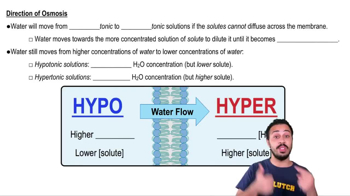
    Osmosis is the passive diffusion of water across a semipermeable membrane, driven by differences in solute concentration. Water moves from a hypotonic solution (lower solute, higher water concentration) to a hypertonic solution (higher solute, lower water concentration) to equalize solute concentrations on both sides of the membrane.
  • How do hypotonic, isotonic, and hypertonic environments affect animal and plant cells differently, and which environments do each type of cell prefer?

    In a hypotonic environment, animal cells may swell and burst (lyse), while plant cells become turgid and maintain structure due to their cell wall—plant cells prefer hypotonic environments. In an isotonic environment, animal cells maintain their size and function optimally, so they prefer this condition; plant cells do not gain turgor pressure and are less supported. In a hypertonic environment, both animal and plant cells lose water and shrink; animal cells dehydrate and may die, while plant cells lose turgor pressure and wilt—neither cell type prefers hypertonic environments.
  • What is osmosis in biological systems?

    Osmosis is the passive diffusion of water across a semipermeable membrane, driven by differences in solute concentration.
  • How does water move in relation to hypotonic and hypertonic solutions during osmosis?

    Water moves from a hypotonic solution (higher water, lower solute) to a hypertonic solution (lower water, higher solute) to equalize solute concentrations.
  • What does the term 'tonicity' refer to when discussing osmosis?

    Tonicity refers to the relative concentration of solutes in two solutions separated by a semipermeable membrane.
  • What happens to an animal cell placed in a hypotonic environment, and why?

    An animal cell in a hypotonic environment swells and may burst (lyse) because water enters the cell due to the lower solute concentration outside.
  • Why do plant cells prefer hypotonic environments?

    Plant cells prefer hypotonic environments because their cell walls prevent bursting, and increased water intake creates turgor pressure that supports the plant's structure.
  • What is the effect of an isotonic environment on animal and plant cells?

    In an isotonic environment, animal cells maintain their size and function optimally, while plant cells do not gain turgor pressure and are less supported.
  • Describe what happens to cells in a hypertonic environment.

    In a hypertonic environment, both animal and plant cells lose water and shrink; animal cells dehydrate and may die, while plant cells lose turgor pressure and wilt.
  • Why must terms like hypotonic, isotonic, and hypertonic always be used in comparison between two regions?

    These terms are comparative and describe the solute concentration of one region relative to another, such as the inside versus the outside of a cell.
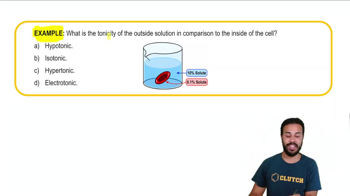
  • What happens to blood cells when they are placed in a hypertonic solution?

    When blood cells are placed in a hypertonic solution, water exits the cells, causing them to shrink and become dehydrated.
  • What is the effect of placing red blood cells in distilled water?

    Placing red blood cells in distilled water, which is a hypotonic environment, causes water to enter the cells, leading them to swell and potentially burst (lyse).
  • How does distilled water affect red blood cells?

    Distilled water creates a hypotonic environment for red blood cells, resulting in water entering the cells, which can cause them to swell and possibly burst.
  • How does drinking alcohol lead to dehydration and affect blood tonicity?

    Drinking alcohol can cause dehydration, which increases the solute concentration in the blood, making it hypertonic. This causes water to leave cells, leading to cellular dehydration.