Skip to main content
Anatomy & Physiology
My Course
Learn
Exam Prep
AI Tutor
Study Guides
Textbook Solutions
Flashcards
Explore
Try the app
My Course
Learn
Exam Prep
AI Tutor
Study Guides
Textbook Solutions
Flashcards
Explore
Try the app
Back
Primary Lymphoid Organs definitions
You can tap to flip the card.
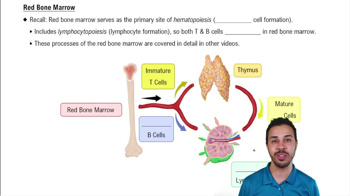
Hematopoiesis
You can tap to flip the card.
👆
Hematopoiesis
The process of blood cell formation, including the production of T and B lymphocytes in the red bone marrow.
Track progress
Control buttons has been changed to "navigation" mode.
1/15
Related flashcards
Related practice
Recommended videos
Primary Lymphoid Organs quiz
Primary Lymphoid Organs
10 Terms
Primary Lymphoid Organs quiz #1
Primary Lymphoid Organs
10 Terms
Primary Lymphoid Organs
20. The Lymphatic System
4 problems
Topic
Secondary Lymphoid Organs: Lymph Nodes
20. The Lymphatic System
4 problems
Topic
20. The Lymphatic System - Part 1 of 2
4 topics
9 problems
Chapter
Jason
20. The Lymphatic System - Part 2 of 2
4 topics
9 problems
Chapter
Bruce
Guided course
8:23
Structure of the Thymus
3390
views
64
rank
Guided course
1:53
Primary Lymphoid Organs Example 2
2753
views
46
rank
Guided course
3:07
Red Bone Marrow
3596
views
74
rank
Terms in this set (15)
Hide definitions
Hematopoiesis
The process of blood cell formation, including the production of T and B lymphocytes in the red bone marrow.
Lymphocytopoiesis
The formation of lymphocytes, specifically T and B cells, originating in the red bone marrow.
Immunocompetent
The state of being capable of carrying out an effective immune response against specific pathogens.
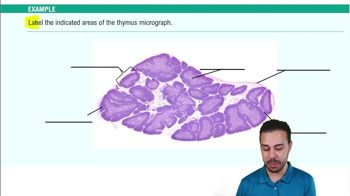
Thymus
A bilobed organ in the mediastinum essential for T cell maturation and selection, part of the lymphatic, immune, and endocrine systems.
Mediastinum
The region in the upper chest behind the sternum, between the lungs, and above the heart, where the thymus is located.
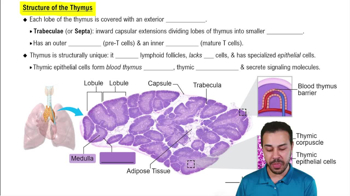
Blood-thymus barrier
A barrier formed by thymic epithelial cells preventing antigens in the blood from disrupting T cell maturation in the thymus.
Trabeculae
Inward capsular extensions of dense irregular connective tissue dividing the thymus lobes into smaller lobules.
Lobules
Smaller compartments within each lobe of the thymus, containing an outer cortex and an inner medulla.
Outer cortex
The region in thymic lobules where premature T cells begin their maturation process.
Inner medulla
The region in thymic lobules containing mature T cells, marked by lighter staining in micrographs.
Thymic corpuscles
Concentric whorls of thymic epithelial cells in the inner medulla, involved in regulatory T cell development.
Regulatory T cells
A special type of T cell developed in the thymus, important for preventing autoimmune diseases.
Adipose tissue
Fatty tissue that accumulates in the thymus as it atrophies with age, replacing thymic tissue.
Thymic epithelial cells
Specialized cells in the thymus forming the blood-thymus barrier and thymic corpuscles, secreting signaling molecules.
Thymic atrophy
The process of the thymus decreasing in size and activity over time, with tissue replaced by fibrous and fatty tissue.
 BackBack

 8:23
8:23