Skip to main content
Anatomy & Physiology
My Course
Learn
Exam Prep
AI Tutor
Study Guides
Textbook Solutions
Flashcards
Explore
Try the app
My Course
Learn
Exam Prep
AI Tutor
Study Guides
Textbook Solutions
Flashcards
Explore
Try the app
Back
Primary Lymphoid Organs quiz
You can tap to flip the card.
What are the primary lymphoid organs?
You can tap to flip the card.
👆
What are the primary lymphoid organs?
Red bone marrow and thymus are primary lymphoid organs.
Track progress
Control buttons has been changed to "navigation" mode.
1/10
Related flashcards
Related practice
Recommended videos
Primary Lymphoid Organs definitions
Primary Lymphoid Organs
15 Terms
Primary Lymphoid Organs quiz #1
Primary Lymphoid Organs
10 Terms
Primary Lymphoid Organs
20. The Lymphatic System
4 problems
Topic
Secondary Lymphoid Organs: Lymph Nodes
20. The Lymphatic System
4 problems
Topic
20. The Lymphatic System - Part 1 of 2
4 topics
9 problems
Chapter
Jason
20. The Lymphatic System - Part 2 of 2
4 topics
9 problems
Chapter
Bruce
Guided course
8:23
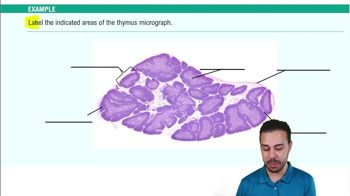
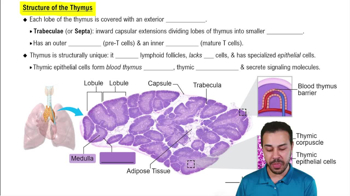
Structure of the Thymus
3095
views
59
rank
Guided course
1:53
Primary Lymphoid Organs Example 2
2518
views
43
rank
Guided course
3:07
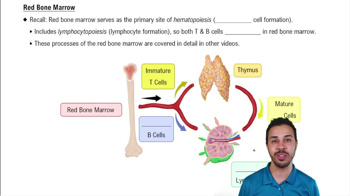
Red Bone Marrow
3283
views
71
rank
Terms in this set (10)
Hide definitions
What are the primary lymphoid organs?
Red bone marrow and thymus are primary lymphoid organs.
What is the primary lymphoid organ responsible for T cell maturation?
The thymus is responsible for T cell maturation.
Where do B cells mature in the body?
B cells mature in the red bone marrow.
Which primary lymphoid organ is located in the mediastinum?
The thymus is located in the mediastinum.
What is the role of the blood-thymus barrier?
The blood-thymus barrier prevents antigens from disrupting T cell maturation in the thymus.
What happens to the thymus as we age?
The thymus atrophies, decreasing in size and activity, but continues to produce T cells at a reduced rate.
Which organ is crucial for hematopoiesis and lymphocytopoiesis?
The red bone marrow is crucial for hematopoiesis and lymphocytopoiesis.
What is the function of thymic corpuscles?
Thymic corpuscles are involved in the development of regulatory T cells, which help prevent autoimmune diseases.
What type of tissue replaces the thymus as it atrophies?
Fibrous and fatty tissue replace the thymus as it atrophies.
What is unique about the thymus compared to other lymphoid organs?
The thymus is unique because it only contains T cells and lacks lymphoid follicles or nodules, which contain B cells.
 BackBack

 8:23
8:23