What is the main hormone secreted by the thymus gland?
The main hormone secreted by the thymus gland is thymosin.
Which hormone does the thymus gland secrete to aid in T cell development?
The thymus gland secretes thymosin, which aids in the development and maturation of T cells.
What hormone is produced by the thymus to support immune function?
The thymus produces thymosin, a hormone that supports the maturation of T lymphocytes and immune function.
Which hormone is released by the thymus gland to influence T cell activity?
The thymus gland releases thymosin, which influences the activity and maturation of T cells.
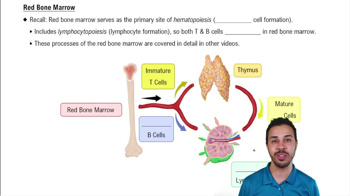
What is the primary site of hematopoiesis in the body?
The primary site of hematopoiesis is the red bone marrow. It produces all blood cells, including T and B lymphocytes.
Where do B cells become immunocompetent before migrating to secondary lymphoid organs?
B cells become immunocompetent in the red bone marrow. After maturation, they migrate to secondary lymphoid organs like lymph nodes.
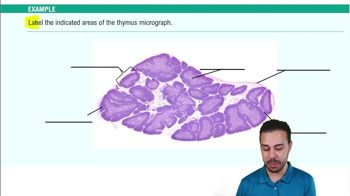
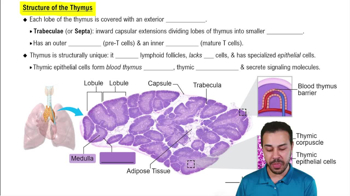
What structural feature divides the thymus into smaller lobules?
The thymus is divided into smaller lobules by trabeculae, which are inward extensions of the capsule. These trabeculae are made of dense irregular connective tissue.
Which cells assist in the maturation of T cells within the thymus lobules?
Dendritic cells assist in the maturation of T cells within both the cortex and medulla of thymus lobules. Macrophages are also present to clean up debris from dead and dying T cells.
What is the function of the blood-thymus barrier in the thymus?
The blood-thymus barrier prevents antigens in the blood from entering the thymus cortex. This protects the T cell maturation process from disruption.
What happens to the thymus as a person ages?
As a person ages, the thymus gradually atrophies and is replaced by fibrous and fatty tissue. Despite this, it continues to produce T cells, but at a reduced rate.
 Back
Back

 8:23
8:23