Back

Renal Physiology: Regulation of Glomerular Filtration quiz

Control buttons has been changed to "navigation" mode.
1/11
  • The filtration pressure in the glomerulus is determined by the balance of which two pressures?

    The filtration pressure in the glomerulus is determined by the balance of hydrostatic pressure and osmotic pressure.
  • What is the effect of hydrostatic pressure of blood on filtration?

    The hydrostatic pressure of blood promotes filtration by pushing fluid out of the glomerular capillaries into the Bowman's capsule.
  • What are the forces opposing filtration at the glomerulus?

    The forces opposing filtration at the glomerulus include the osmotic pressure of the blood and the hydrostatic pressure in the Bowman's capsule.
  • Which factor would increase the glomerular filtration rate?

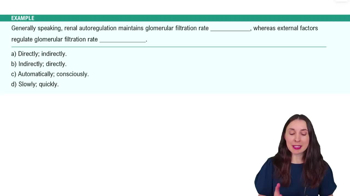
    Factors such as increased blood pressure, vasodilation of the afferent arteriole, and vasoconstriction of the efferent arteriole would increase the glomerular filtration rate.
  • How and where are hydrogen ions secreted?

    Hydrogen ions are secreted in the distal tubule and collecting duct of the nephron through active transport mechanisms.
  • What causes a decrease in glomerular capillary pressure?

    Vasoconstriction of the afferent arteriole and vasodilation of the efferent arteriole result in a decrease in glomerular capillary pressure.
  • How can water in the filtrate be reabsorbed in the blood?

    Water in the filtrate can be reabsorbed into the blood through osmosis, primarily in the proximal tubule and collecting duct, following the reabsorption of sodium.
  • What factors decrease the glomerular filtration rate?

    Decreased blood pressure, vasoconstriction of the afferent arteriole, and vasodilation of the efferent arteriole would decrease glomerular filtration rate.
  • What effect does constricting the efferent arteriole have on the filtration process?

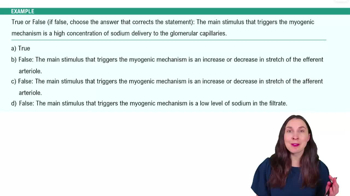
    Constricting the efferent arteriole increases glomerular filtration pressure and rate by causing blood to back up in the glomerulus.
  • What causes the release of renin from the juxtaglomerular apparatus?

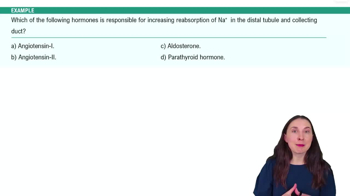
    The release of renin from the juxtaglomerular apparatus is caused by low blood pressure, low sodium levels, or increased sympathetic nervous system activity.
  • What occurs when plasma glucose concentration exceeds the renal plasma threshold?

    When plasma glucose concentration exceeds the renal plasma threshold, glucose appears in the urine because the transport maximum for glucose reabsorption is surpassed.