Pearson+ LogoPearson+ Logo
Back

Renal Physiology Step 2: Tubular Reabsorption quiz #1

Control buttons has been changed to "navigation" mode.
1/10
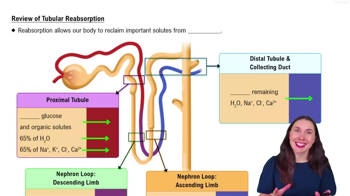
  • In which part of the nephron is glucose (sugar) primarily removed from the blood during renal tubular reabsorption?

    Glucose is primarily removed from the blood in the proximal tubule of the nephron, where over 99% of glucose is reabsorbed from the filtrate back into the bloodstream.
  • What are the two main routes substances can take during tubular reabsorption in the nephron?

    The two main routes are the transcellular route, where substances pass through tubule cells, and the paracellular route, where substances pass between tubule cells. Both routes allow water and solutes to move from the filtrate back into the bloodstream.
  • How does the structure of the proximal tubule facilitate its high rate of reabsorption?

    The proximal tubule has prominent microvilli that greatly increase its surface area. This structural adaptation allows for efficient and rapid reabsorption of water, ions, and nutrients.
  • What role does the sodium-potassium pump play in sodium reabsorption in the proximal tubule?

    The sodium-potassium pump, located on the basolateral membrane, actively transports sodium out of the tubule cell into the interstitial space. This creates a concentration gradient that drives further sodium entry from the filtrate into the cell.
  • How does secondary active transport contribute to nutrient reabsorption in the proximal tubule?

    Secondary active transport uses the energy from the sodium concentration gradient to co-transport nutrients like glucose into the tubule cell. This process allows nutrients to move against their own concentration gradients without directly using ATP.
  • What is obligatory water reabsorption and what drives it in the proximal tubule?

    Obligatory water reabsorption refers to water being reabsorbed due to an osmotic gradient created by solute reabsorption. Water follows solutes through aquaporins, moving from areas of low to high solute concentration.
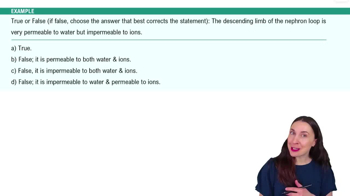
  • How do the descending and ascending limbs of the nephron loop differ in their permeability to water and ions?

    The descending limb is permeable to water but not ions, allowing water reabsorption via aquaporins. The ascending limb is impermeable to water but actively reabsorbs ions like sodium, potassium, and chloride.
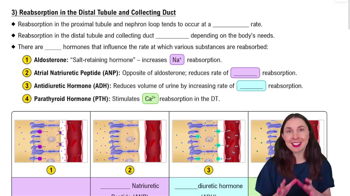
  • Which hormones regulate reabsorption in the distal tubule and collecting duct, and what does each primarily affect?

    Aldosterone increases sodium reabsorption, ANP decreases sodium reabsorption, ADH increases water reabsorption, and PTH increases calcium reabsorption. Each hormone adjusts reabsorption rates based on the body's needs.
  • What happens when the transport maximum for a substance in the kidney is exceeded?

    When transport maximum is exceeded, all available transport proteins are saturated and any excess of the substance remains in the filtrate. This excess is then excreted in the urine.
  • How does the renal threshold relate to the appearance of substances in urine?

    The renal threshold is the plasma concentration at which a substance begins to appear in the urine. If blood levels of the substance exceed this threshold, the kidneys cannot reabsorb all of it, and the excess is excreted.