Skip to main content
Anatomy & Physiology
My Course
Learn
Exam Prep
AI Tutor
Study Guides
Textbook Solutions
Flashcards
Explore
Try the app
My Course
Learn
Exam Prep
AI Tutor
Study Guides
Textbook Solutions
Flashcards
Explore
Try the app
Back
Review of the Sympathetic and Parasympathetic Divisions definitions
You can tap to flip the card.
Dual innervation
You can tap to flip the card.
👆
Dual innervation
Refers to organs receiving inputs from both sympathetic and parasympathetic nervous systems.
Track progress
Control buttons has been changed to "navigation" mode.
1/15
Related flashcards
Related practice
Recommended videos
Review of the Sympathetic and Parasympathetic Divisions quiz
Review of the Sympathetic and Parasympathetic Divisions
10 Terms
Review of the Sympathetic and Parasympathetic Divisions
14. The Autonomic Nervous System
1 problem
Topic
Bruce
Neurotransmitters of the ANS
14. The Autonomic Nervous System
7 problems
Topic
Jason
14. The Autonomic Nervous System
6 topics
13 problems
Chapter
Jason
0:52
Review of the Sympathetic and Parasympathetic Divisions Example 1
4280
views
127
rank
4:39
Review of the Sympathetic and Parasympathetic Divisions
5485
views
98
rank
2
comments
Terms in this set (15)
Hide definitions
Dual innervation
Refers to organs receiving inputs from both sympathetic and parasympathetic nervous systems.
Sympathetic fibers
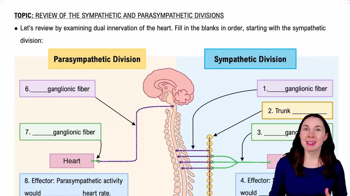
Originate from spinal cord segments T1-L2, increase heart rate, and have short preganglionic fibers.
Parasympathetic fibers
Originate from cranial and sacral regions, decrease heart rate, and have long preganglionic fibers.
Preganglionic fiber
Nerve fiber that extends from the central nervous system to a ganglion.
Postganglionic fiber
Nerve fiber that extends from a ganglion to an effector organ.
Sympathetic trunk
Chain of ganglia located near the spinal cord where sympathetic fibers synapse.
Collateral ganglia
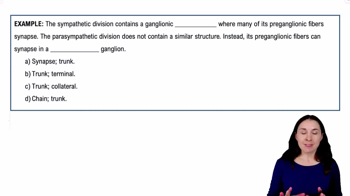
Ganglia where some sympathetic fibers synapse, bypassing the sympathetic trunk.
Terminal ganglia
Ganglia located near or on effector organs where parasympathetic fibers synapse.
Splanchnic nerves
Nerves that bypass the sympathetic trunk to synapse in collateral ganglia.
Effector organ
Target organ or tissue that responds to nerve impulses.
Cranial region
Area of the brainstem where parasympathetic fibers originate.
Sacral region
Lower spinal region where parasympathetic fibers originate.
Fight or flight response
Physiological reaction to perceived harmful events, activated by sympathetic nervous system.
Rest and digest effect
State of relaxation and digestion promoted by parasympathetic nervous system.
Synapse
Junction between two nerve cells where impulses pass by diffusion of neurotransmitters.
 BackBack

 0:52
0:52