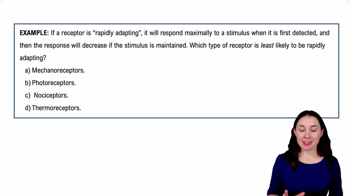
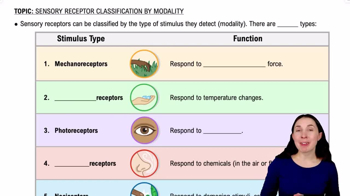
Sensory Receptor Classification by Modality definitions Flashcards

Sensory Receptor Classification by Modality definitions
Control buttons has been changed to "navigation" mode.
1/15
  • Mechanoreceptors
    Detect mechanical forces like pressure or vibration, responding to physical changes in the environment.
  • Thermoreceptors
    Sensitive to changes in temperature, not static levels, detecting variations in thermal conditions.
  • Photoreceptors
    Respond to light stimuli, enabling the perception of visual information.
  • Chemoreceptors
    React to chemical substances in air, food, or bodily fluids, crucial for taste and smell.
  • Nociceptors
    Activate in response to potentially damaging stimuli, signaling pain when harm is imminent.
  • Stimulus
    An external factor or change that elicits a response from sensory receptors.
  • Modality
    Refers to the type of stimulus detected by sensory receptors, such as mechanical or chemical.
  • Pressure
    A mechanical force that can be detected by mechanoreceptors, often perceived as touch.
  • Vibration
    A type of mechanical force sensed by mechanoreceptors, involving oscillatory motion.
  • Temperature
    A measure of thermal energy, changes of which are detected by thermoreceptors.
  • Light
    Electromagnetic radiation visible to the human eye, detected by photoreceptors.
  • Chemicals
    Substances that can trigger chemoreceptors, found in air, food, or bodily fluids.
  • Pain
    A sensory experience resulting from activation of nociceptors by harmful stimuli.
  • Damage
    Physical harm or injury that can activate nociceptors, leading to pain perception.
  • Bodily Fluids
    Liquids within the body, such as blood, that can contain chemicals detected by chemoreceptors.