Skip to main content
Anatomy & Physiology
My Course
Learn
Exam Prep
AI Tutor
Study Guides
Textbook Solutions
Flashcards
Explore
Try the app
My Course
Learn
Exam Prep
AI Tutor
Study Guides
Textbook Solutions
Flashcards
Explore
Try the app
Back
Small Intestine definitions
You can tap to flip the card.
Duodenum
You can tap to flip the card.
👆
Duodenum
The first section of the small intestine, mixing chyme with bile and pancreatic juice, and releasing alkaline mucus.
Track progress
Control buttons has been changed to "navigation" mode.
1/15
Related flashcards
Related practice
Recommended videos
Small Intestine quiz
Small Intestine
10 Terms
Small Intestine
23. The Digestive System
4 problems
Topic
Duct System of the Liver, Gallbladder, and Pancreas
23. The Digestive System
4 problems
Topic
23. The Digestive System - Part 1 of 2
4 topics
11 problems
Chapter
Jason
23. The Digestive System - Part 2 of 2
2 topics
5 problems
Chapter
3:06
Motility in the Small Intestine
3187
views
37
rank
2:25
Small Intestine Example 3
2987
views
37
rank
1
comments
2:25
Small Intestine Example 1
3255
views
51
rank
Terms in this set (15)
Hide definitions
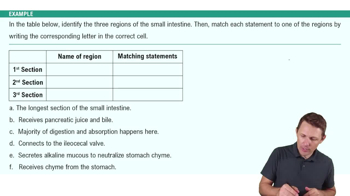
Duodenum
The first section of the small intestine, mixing chyme with bile and pancreatic juice, and releasing alkaline mucus.
Jejunum
The middle section of the small intestine, primarily responsible for nutrient absorption through microvilli.
Ileum
The longest section of the small intestine, absorbing bile salts and remaining nutrients.
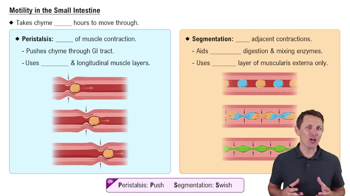
Peristalsis
A wave of muscle contraction that moves chyme through the gastrointestinal tract.
Segmentation
Non-adjacent muscle contractions in the small intestine aiding in mechanical digestion and mixing.
Microvilli
Membrane projections on enterocytes, increasing surface area for absorption and containing brush border enzymes.
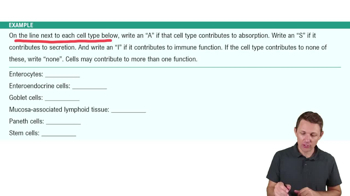
Enterocytes
Simple columnar cells specialized for absorption in the small intestine, lining the villi.
Goblet cells
Cells in the intestinal mucosa that secrete mucus to lubricate the alimentary canal.
Peyer's patches
Aggregated lymphoid nodules in the ileum protecting against pathogens from the large intestine.
Paneth cells
Cells at the base of intestinal crypts secreting antimicrobial agents like lysozyme and defensins.
Brush border
The microvilli-covered surface of enterocytes, containing enzymes for the final steps of digestion.
Circular folds
Folds of the mucosa and submucosa in the small intestine, increasing surface area and slowing chyme flow.
Ileocecal valve
The sphincter separating the ileum from the cecum of the large intestine, controlling chyme passage.
Chyme
The semi-fluid mass of partly digested food that moves from the stomach to the small intestine.
Lacteal
A lymph vessel within the villi of the small intestine, absorbing lipids from digested food.
 BackBack
 3:06
3:06