Skip to main content
Anatomy & Physiology
My Course
Learn
Exam Prep
AI Tutor
Study Guides
Textbook Solutions
Flashcards
Explore
Try the app
My Course
Learn
Exam Prep
AI Tutor
Study Guides
Textbook Solutions
Flashcards
Explore
Try the app
Back
Steps of Muscle Contraction definitions
3 students found this helpful
You can tap to flip the card.
Neuromuscular Junction
You can tap to flip the card.
👆
Neuromuscular Junction
The site where a motor neuron communicates with a muscle fiber, initiating muscle contraction.
Track progress
Control buttons has been changed to "navigation" mode.
1/15
Related flashcards
Related practice
Recommended videos
Steps of Muscle Contraction quiz
Steps of Muscle Contraction
23 Terms
Steps of Muscle Contraction quiz #1
Steps of Muscle Contraction
23 Terms
Steps of Muscle Contraction
9. Muscle Tissue
7 problems
Topic
Jason
Sliding Filament Theory and the Sacromere
9. Muscle Tissue
3 problems
Topic
Bruce
9. Muscle Tissue
4 topics
11 problems
Chapter
Jason
5:47
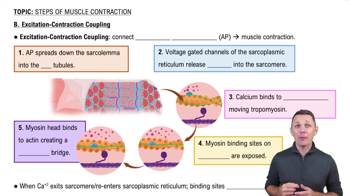
B. Excitation-Contraction Coupling
11073
views
252
rank
2
comments
7:39
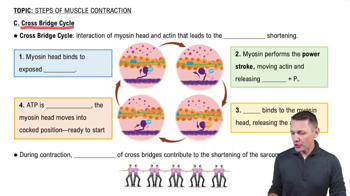
C. Cross Bridge Cycle
10384
views
210
rank
3
comments
3:26
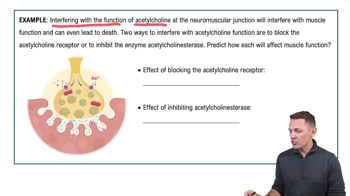
Steps of Muscle Contraction Example 3
9590
views
183
rank
Terms in this set (15)
Hide definitions
Neuromuscular Junction
The site where a motor neuron communicates with a muscle fiber, initiating muscle contraction.
Acetylcholine
A neurotransmitter released at the neuromuscular junction to trigger muscle contraction.
Sarcolemma
The cell membrane of a muscle fiber that conducts action potentials.
T-tubules
Invaginations of the sarcolemma that help propagate action potentials into the muscle fiber.
Sarcoplasmic Reticulum
A specialized endoplasmic reticulum in muscle cells that stores and releases calcium ions.
Calcium Ions
Ions released from the sarcoplasmic reticulum that bind to troponin to initiate contraction.
Troponin
A protein that binds calcium ions, causing tropomyosin to expose myosin binding sites on actin.
Tropomyosin
A protein that blocks myosin binding sites on actin filaments in resting muscle.
Cross-bridge
The connection formed when myosin heads bind to actin filaments during muscle contraction.
Power Stroke
The action of myosin pulling actin filaments toward the center of the sarcomere.
ATP Hydrolysis
The process of breaking down ATP to ADP and inorganic phosphate, providing energy for muscle contraction.
Depolarization
A change in cell membrane potential that makes the inside of the cell more positive.
Repolarization
The process of restoring the resting membrane potential after depolarization.
Acetylcholinesterase
An enzyme that breaks down acetylcholine in the synaptic cleft, ending muscle contraction.
Myofibril
A basic rod-like unit of a muscle cell, composed of repeating sarcomeres.
 BackBack

 5:47
5:47