Skip to main content
Anatomy & Physiology
My Course
Learn
Exam Prep
AI Tutor
Study Guides
Textbook Solutions
Flashcards
Explore
Try the app
My Course
Learn
Exam Prep
AI Tutor
Study Guides
Textbook Solutions
Flashcards
Explore
Try the app
Back
Structure of a Skeletal Muscle definitions
4 students found this helpful
You can tap to flip the card.
Skeletal Muscle
You can tap to flip the card.
👆
Skeletal Muscle
A type of muscle tissue that is attached to bones and is responsible for voluntary movements.
Track progress
Control buttons has been changed to "navigation" mode.
1/15
Related flashcards
Related practice
Recommended videos
Structure of a Skeletal Muscle quiz
Structure of a Skeletal Muscle
27 Terms
Structure of a Skeletal Muscle quiz #1
Structure of a Skeletal Muscle
31 Terms
Structure of a Skeletal Muscle
9. Muscle Tissue
7 problems
Topic
Jason
Sliding Filament Theory and the Sacromere
9. Muscle Tissue
3 problems
Topic
Bruce
9. Muscle Tissue
4 topics
11 problems
Chapter
Jason
7:47
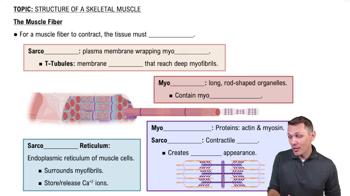
The Muscle Fiber
17111
views
340
rank
4
comments
2:46
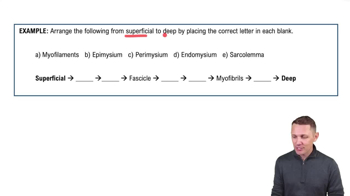
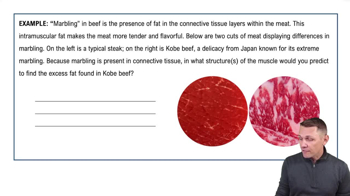
Structure of a Skeletal Muscle Example 2
12832
views
261
rank
1
comments
3:04
Structure of a Skeletal Muscle Example 1
14289
views
230
rank
Terms in this set (15)
Hide definitions
Skeletal Muscle
A type of muscle tissue that is attached to bones and is responsible for voluntary movements.
Muscle Fiber
A single muscle cell, long and multinucleated, that makes up the bulk of skeletal muscle.
Fascicle
A bundle of muscle fibers surrounded by connective tissue called perimysium.
Endomysium
A layer of connective tissue that surrounds each individual muscle fiber.
Perimysium
Connective tissue that surrounds a fascicle, or bundle of muscle fibers.
Epimysium
The outer layer of connective tissue that surrounds the entire muscle.
Tendon
A rope-like structure formed by connective tissues that connects muscle to bone.
Aponeurosis
A flat, sheet-like connective tissue that connects muscles to bones.
Sarcolemma
The specialized cell membrane of a muscle fiber that transmits electrochemical signals.
T Tubules
Membrane canals that extend from the sarcolemma into the muscle fiber, aiding signal transmission.
Sarcoplasmic Reticulum
A specialized endoplasmic reticulum in muscle cells that stores and releases calcium ions.
Myofibril
Rod-like organelles within muscle fibers, composed of repeating units of myofilaments.
Myofilaments
Protein filaments, primarily actin and myosin, responsible for muscle contraction.
Sarcomere
The fundamental contractile unit of muscle, composed of repeating actin and myosin structures.
Striated Appearance
The striped look of skeletal muscle due to the organized arrangement of sarcomeres.
 BackBack

 7:47
7:47