Skip to main content
Anatomy & Physiology
My Course
Learn
Exam Prep
AI Tutor
Study Guides
Textbook Solutions
Flashcards
Explore
Try the app
My Course
Learn
Exam Prep
AI Tutor
Study Guides
Textbook Solutions
Flashcards
Explore
Try the app
Back
Structure of the Eyeball definitions
4 students found this helpful
You can tap to flip the card.
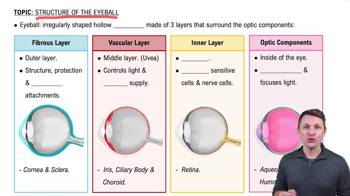
Fibrous Layer
You can tap to flip the card.
👆
Fibrous Layer
The outermost layer of the eye providing structure, protection, and muscle attachments for movement.
Track progress
Control buttons has been changed to "navigation" mode.
1/15
Related flashcards
Related practice
Recommended videos
Structure of the Eyeball quiz #1
Structure of the Eyeball
40 Terms
Structure of the Eyeball quiz #2
Structure of the Eyeball
3 Terms
Structure of the Eyeball quiz #3
Structure of the Eyeball
12 Terms
Structure of the Eyeball
15. The Special Senses
2 problems
Topic
Fibrous Layer of the Eyeball
15. The Special Senses
2 problems
Topic
15. The Special Senses
8 topics
13 problems
Chapter
Bruce
4:16
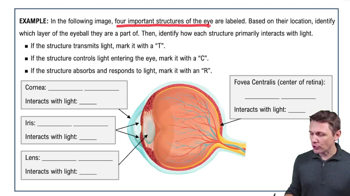
Structure of the Eyeball Example 1
6069
views
130
rank
1
comments
5:21
Eyeball
7561
views
170
rank
2
comments
Terms in this set (15)
Hide definitions
Fibrous Layer
The outermost layer of the eye providing structure, protection, and muscle attachments for movement.
Cornea
The clear front part of the eye that allows light to enter and provides a protective barrier.
Sclera
The white part of the eye, providing structural support and protection.
Vascular Layer
The middle layer of the eye, responsible for controlling light entry and providing blood supply.
Iris
The colored part of the eye that controls the amount of light entering the eyeball.
Ciliary Body
Contains muscles that alter the lens shape for focusing light on the retina.
Choroid
A pigmented layer that absorbs stray light to prevent vision artifacts.
Retina
The inner layer containing photosensitive and nerve cells essential for capturing light.
Optic Nerve
Transmits visual information from the retina to the brain.
Aqueous Humor
A clear liquid filling the front of the eye, helping maintain pressure and nutrient transport.
Vitreous Humor
A gel-like substance filling most of the eye, maintaining its shape and allowing light passage.
Lens
A flexible structure that focuses light onto the retina for clear vision.
Photosensitive Cells
Cells in the retina that detect light and initiate visual processing.
Nerve Cells
Cells in the retina that transmit visual signals to the brain via the optic nerve.
Electromagnetic Radiation
Light waves that the eye focuses to perceive colors and images.
 BackBack
 4:16
4:16