Skip to main content
Anatomy & Physiology
My Course
Learn
Exam Prep
AI Tutor
Study Guides
Textbook Solutions
Flashcards
Explore
Try the app
My Course
Learn
Exam Prep
AI Tutor
Study Guides
Textbook Solutions
Flashcards
Explore
Try the app
Back
The Epidermis: Layers definitions
You can tap to flip the card.
Epidermis
You can tap to flip the card.
👆
Epidermis
The outermost layer of skin composed of several distinct layers of cells.
Track progress
Control buttons has been changed to "navigation" mode.
1/15
Related flashcards
Related practice
Recommended videos
The Epidermis: Layers quiz
The Epidermis: Layers
10 Terms
The Epidermis: Layers quiz #1
The Epidermis: Layers
16 Terms
The Epidermis: Layers
5. Integumentary System
7 problems
Topic
Bruce
The Dermis
5. Integumentary System
3 problems
Topic
Bruce
5. Integumentary System - Part 1 of 2
4 topics
8 problems
Chapter
Bruce
5. Integumentary System - Part 2 of 2
5 topics
8 problems
Chapter
Bruce
Guided course
02:36
The Epidermis: Layers Example 1
9452
views
198
rank
2
comments
Guided course
04:52
Epidermal Layers: Stratum Spinosum (Spiny Layer)
9725
views
193
rank
Guided course
04:34
The Epidermis: Layers Example 3
7144
views
147
rank
Terms in this set (15)
Hide definitions
Epidermis
The outermost layer of skin composed of several distinct layers of cells.
Stratum Basale
The deepest epidermal layer containing stem cells, keratinocytes, melanocytes, and tactile epithelial cells.
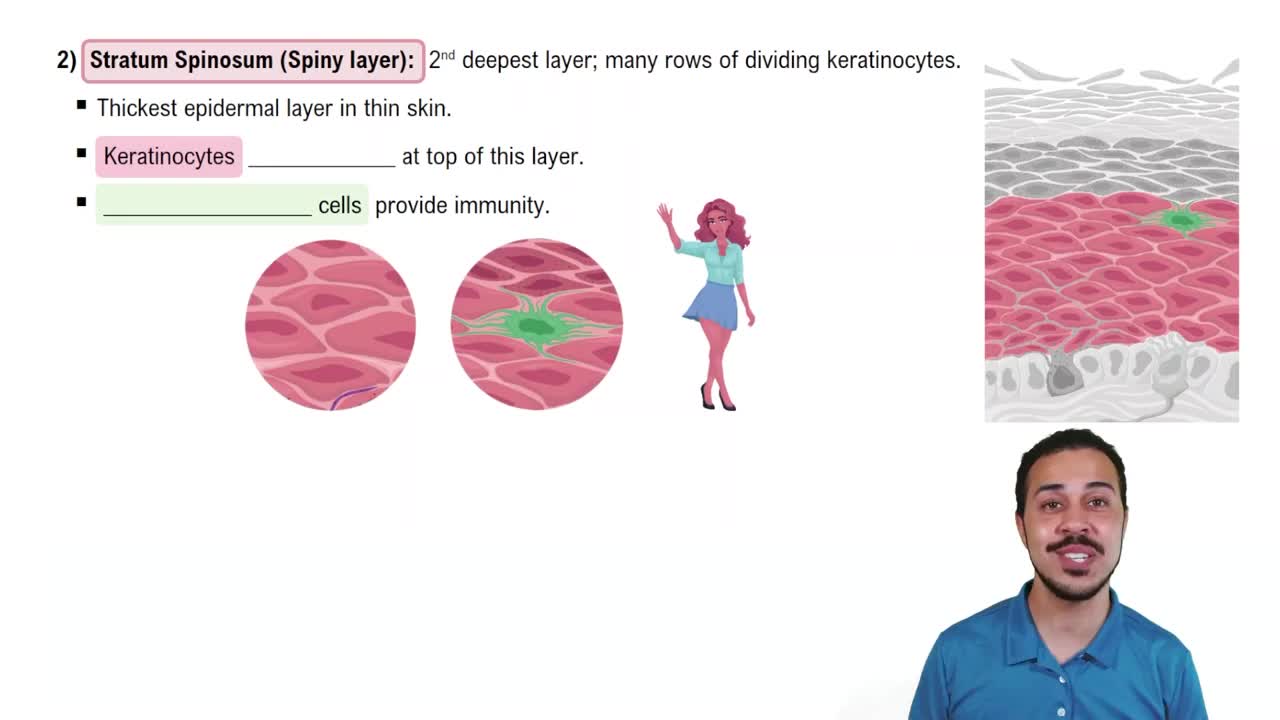
Stratum Spinosum
The second deepest layer with dividing keratinocytes and dendritic cells, known for its spiny appearance.
Stratum Granulosum
The third layer where keratinocytes stop dividing, harden, and begin to die.
Stratum Lucidum
A clear, protective layer found only in thick skin, consisting of dead keratinocytes.
Stratum Corneum
The most superficial layer, consisting of dead, keratin-filled cells that are regularly shed.
Keratinocytes
Cells that produce keratin, originating in the stratum basale and moving upwards.
Melanocytes
Cells in the stratum basale that produce melanin to protect skin from UV damage.
Tactile Epithelial Cells
Cells in the stratum basale that work with nervous tissue to allow touch sensations.
Dendritic Cells
Immune cells in the stratum spinosum that activate the immune system.
Keratohyalin Granules
Granules in the stratum granulosum that help with keratin aggregation and cell hardening.
Lamellar Granules
Granules containing glycolipids that waterproof the stratum granulosum.
Thin Skin
Skin type lacking the stratum lucidum, containing hair follicles and oil glands.
Thick Skin
Skin type with all epidermal layers, including the stratum lucidum, found on palms and soles.
Keratin
A tough, fibrous protein produced by keratinocytes, providing skin with protective properties.
 BackBack
 02:36
02:36