Skip to main content
Anatomy & Physiology
My Course
Learn
Exam Prep
AI Tutor
Study Guides
Textbook Solutions
Flashcards
Explore
Try the app
My Course
Learn
Exam Prep
AI Tutor
Study Guides
Textbook Solutions
Flashcards
Explore
Try the app
Back
The Nephron quiz #1
1 student found this helpful
You can tap to flip the card.
What are the two main parts of the nephron?
You can tap to flip the card.
👆
What are the two main parts of the nephron?
The two main parts of the nephron are the renal corpuscle and the renal tubule.
Track progress
Control buttons has been changed to "navigation" mode.
1/39
Related flashcards
Related practice
Recommended videos
The Nephron definitions
The Nephron
15 Terms
The Nephron quiz #2
The Nephron
38 Terms
The Nephron quiz #3
The Nephron
40 Terms
The Nephron
25. The Urinary System
3 problems
Topic
Jason
Blood Supply of the Kidneys
25. The Urinary System
5 problems
Topic
Bruce
25. The Urinary System - Part 1 of 2
4 topics
10 problems
Chapter
Bruce
25. The Urinary System - Part 2 of 2
5 topics
11 problems
Chapter
Jason
3:50
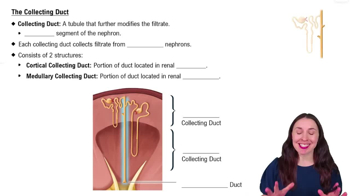
The Collecting Duct
5358
views
103
rank
4:52
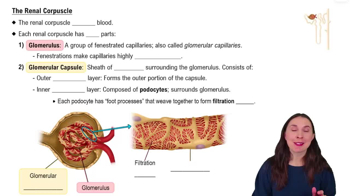
The Renal Corpuscle
6702
views
138
rank
0:47
The Nephron Example 2
5454
views
83
rank
Terms in this set (39)
Hide definitions
What are the two main parts of the nephron?
The two main parts of the nephron are the renal corpuscle and the renal tubule.
What is the functional unit of the kidney?
Nephron
Which of these is the functional unit of a kidney?
The functional unit of a kidney is the nephron.
About how many nephrons are in a kidney?
Each kidney contains about 1 to 2 million nephrons.
What is the correct sequence for parts of the renal tubule?
The correct sequence is proximal tubule, nephron loop, distal tubule.
What components make up the renal tubule?
Proximal tubule, nephron loop, distal tubule
Which choice describes the countercurrent mechanism of the nephron loop?
The countercurrent mechanism in the nephron loop helps concentrate urine by creating a gradient in the medulla.
Which part of the nephron is influenced by hormones to absorb sodium and water?
The distal tubule and collecting duct are influenced by hormones to absorb sodium and water.
From how many nephrons does one collecting duct receive tubular fluid?
Multiple nephrons
Which is the term for the functional units of the kidneys?
The term for the functional units of the kidneys is nephrons.
What is the correct order of components of a nephron starting from the glomerulus?
Glomerulus, proximal tubule, nephron loop, distal tubule
Which structure is not associated with the renal corpuscle?
Proximal tubule
From which part of the nephron does the collecting duct receive fluid?
Distal tubule
What is the order in which blood flows through the nephron?
Glomerulus, proximal tubule, nephron loop, distal tubule
A nephron consists of what two parts?
A nephron consists of the renal corpuscle and the renal tubule.
Where is the majority of the nephron loops located?
Renal medulla
The renal corpuscle includes what two structures?
The renal corpuscle includes the glomerulus and the glomerular capsule.
Which of the choices below is a function of the nephron loop?
The nephron loop functions in concentrating urine by creating a gradient in the medulla.
How many nephrons does each kidney have?
Each kidney has about 1 to 2 million nephrons.
Which process in the nephron is least selective?
Filtration in the glomerulus is the least selective process in the nephron.
Which are the two major components of a nephron?
The two major components of a nephron are the renal corpuscle and the renal tubule.
What are the two main parts of a nephron?
The two main parts of a nephron are the renal corpuscle and the renal tubule.
Aquaporins allow what to pass through the descending limb of loop of Henle?
Aquaporins allow water to pass through the descending limb of the loop of Henle.
A nephron consists of what structures?
A nephron consists of the renal corpuscle and the renal tubule.
Which part of the nephron performs the majority of water reabsorption?
The proximal tubule performs the majority of water reabsorption.
What happens when the concentration of Na+ decreases in the ascending limb of the nephron?
When the concentration of Na+ decreases in the ascending limb, less sodium is reabsorbed, affecting the osmotic gradient.
Which structures make up the renal corpuscle?
The renal corpuscle is made up of the glomerulus and the glomerular capsule.
What are the two major components of a nephron?
The two major components of a nephron are the renal corpuscle and the renal tubule.
What does the countercurrent mechanism accomplish in the nephron loop?
The countercurrent mechanism in the nephron loop helps concentrate urine by creating a gradient in the medulla.
Which structure in the nephron collects urine from the distal convoluted tubule?
The collecting duct collects urine from the distal convoluted tubule.
Most water is reabsorbed from the filtrate by which region of the nephron?
Most water is reabsorbed by the proximal tubule.
Water is absorbed from what part of the loop of the nephron?
Water is absorbed from the descending limb of the nephron loop.
The nephron is broken down into which two major portions?
The nephron is broken down into the renal corpuscle and the renal tubule.
What effect does antidiuretic hormone (ADH) have on the nephron?
ADH increases water reabsorption in the distal tubule and collecting duct.
What percentage of all nephrons are cortical nephrons?
They make up 80% of all nephrons
What is the correct path of filtrate through a nephron of the kidney as it is processed into urine?
The correct path is glomerulus, proximal tubule, nephron loop, distal tubule, collecting duct.
What structure in the kidney acts as the countercurrent multiplier?
Nephron loop
What is the role of the collecting ducts?
The collecting ducts further modify filtrate and collect it from multiple nephrons, eventually leading to urine formation.
Where in the nephron does most solute reabsorption occur?
Most solute reabsorption occurs in the proximal tubule.
 BackBack

 3:50
3:50