The Refractory Period definitions Flashcards
The Refractory Period definitions
You can tap to flip the card.
Control buttons has been changed to "navigation" mode.
1/12
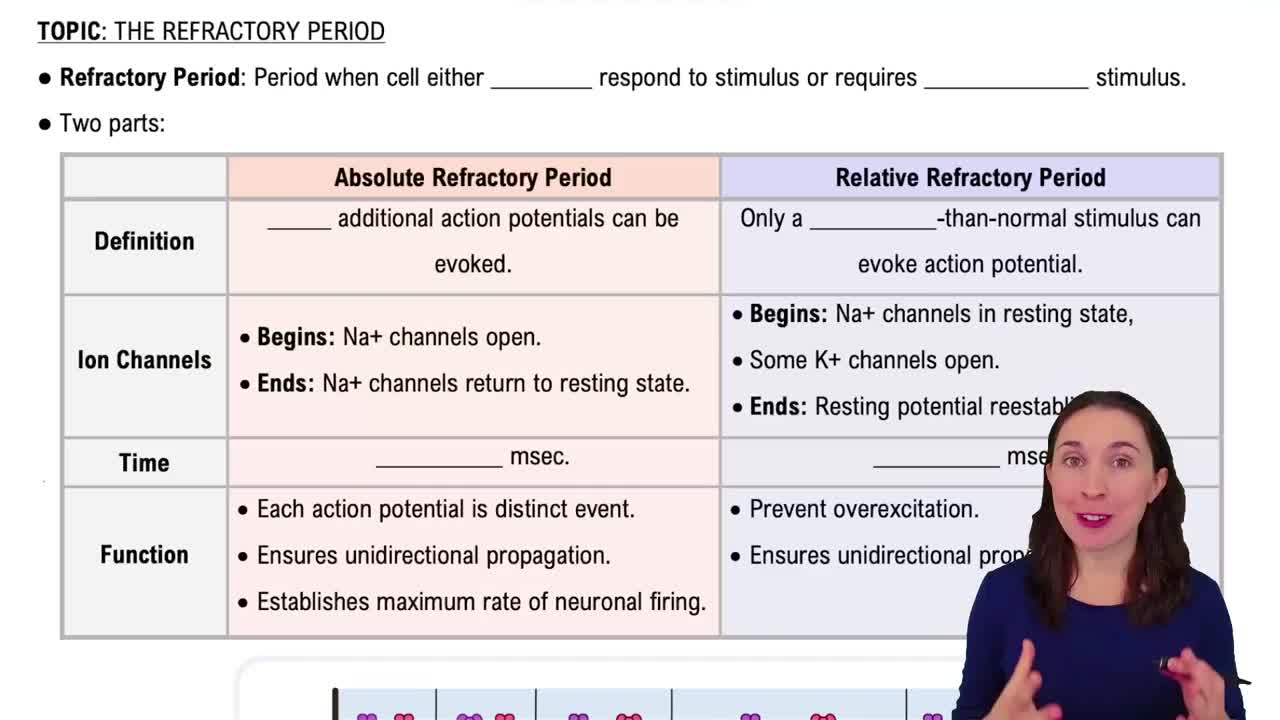
Refractory PeriodA phase during an action potential where a neuron is less responsive to stimuli, ensuring distinct action potentials.Action PotentialA rapid rise and fall in voltage across a cell membrane, essential for nerve signal transmission.Absolute Refractory PeriodA phase where no new action potentials can be initiated, ensuring unidirectional signal propagation.Relative Refractory PeriodA phase following the absolute period where a stronger stimulus is needed to initiate an action potential.Voltage-Gated Sodium ChannelsMembrane proteins that open in response to voltage changes, crucial for action potential initiation.Resting StateThe state of a neuron when it is not transmitting an action potential, typically at -70 millivolts.HyperpolarizationAn increase in membrane potential making the inside of the cell more negative, occurring during the relative refractory period.DepolarizationA decrease in membrane potential, making the inside of the cell less negative, essential for action potential initiation.Unidirectional PropagationThe one-way travel of an action potential along an axon, ensured by the refractory periods.Neuronal Firing RateThe frequency at which a neuron can generate action potentials, limited by the absolute refractory period.Potassium ChannelsMembrane proteins that allow potassium ions to pass, involved in returning the cell to resting potential.ThresholdThe critical level to which a membrane potential must be depolarized to initiate an action potential.