Skip to main content
Anatomy & Physiology
My Course
Learn
Exam Prep
AI Tutor
Study Guides
Textbook Solutions
Flashcards
Explore
Try the app
My Course
Learn
Exam Prep
AI Tutor
Study Guides
Textbook Solutions
Flashcards
Explore
Try the app
Back
The Thoracic Cage definitions
1 student found this helpful
You can tap to flip the card.
Thoracic Cage
You can tap to flip the card.
👆
Thoracic Cage
A bony structure protecting the thoracic cavity, consisting of thoracic vertebrae, ribs, sternum, and intercostal cartilage.
Track progress
Control buttons has been changed to "navigation" mode.
1/13
Related flashcards
Related practice
Recommended videos
The Thoracic Cage quiz
The Thoracic Cage
10 Terms
The Thoracic Cage quiz #1
The Thoracic Cage
10 Terms
The Thoracic Cage
7. The Skeletal System
3 problems
Topic
Bruce
The Pectoral Girdle
7. The Skeletal System
4 problems
Topic
Jason
7. The Skeletal System - Part 1 of 2
7 topics
14 problems
Chapter
Bruce
7. The Skeletal System - Part 2 of 2
1 topic
2 problems
Chapter
Jason
5:03
Thoracic Cage
10101
views
200
rank
1
comments
2:45
The Thoracic Cage Example 1
7650
views
145
rank
Terms in this set (13)
Hide definitions
Thoracic Cage
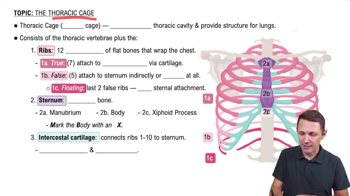
A bony structure protecting the thoracic cavity, consisting of thoracic vertebrae, ribs, sternum, and intercostal cartilage.
Thoracic Cavity
The chest cavity housing vital organs like the lungs and heart, protected by the thoracic cage.
Thoracic Vertebrae
Twelve vertebrae in the spine that articulate with the ribs, forming part of the thoracic cage.
Ribs
Twelve pairs of flat bones forming the thoracic cage, providing protection and support.
True Ribs
The first seven pairs of ribs that attach directly to the sternum via their own costal cartilage.
False Ribs
Ribs 8 to 10 that attach to the sternum indirectly through cartilage connecting to other rib cartilage.
Floating Ribs
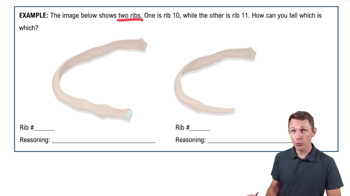
The last two pairs of ribs (11 and 12) that do not attach to the sternum.
Sternum
A flat bone resembling a necktie, composed of the manubrium, body, and xiphoid process.
Manubrium
The upper part of the sternum, resembling the knot of a necktie.
Body
The central part of the sternum, forming the long section of the necktie shape.
Xiphoid Process
The small, cartilaginous tip of the sternum, serving as an attachment point.
Intercostal Cartilage
Flexible cartilage connecting ribs 1 through 10 to the sternum, providing strength and flexibility.
Costal Cartilage
Cartilage that connects ribs to the sternum, allowing for flexibility and movement.
 BackBack

 5:03
5:03