Types of Phosphorylation quiz Flashcards

Types of Phosphorylation quiz
Control buttons has been changed to "navigation" mode.
1/10
  • At what number carbon does the phosphate group connect to the sugar in a nucleotide?
    The phosphate group connects to the 5' carbon of the sugar in a nucleotide.
  • Where do the phosphate groups come from that are added to proteins during phosphorylation?
    Phosphate groups are typically transferred from ATP molecules during phosphorylation.
  • What protein is phosphorylated first during receptor tyrosine kinase (RTK) activation?
    The receptor tyrosine kinase itself is phosphorylated first during its activation.
  • Activation of which of the following molecules generally requires protein phosphorylation: enzymes, lipids, carbohydrates, or nucleic acids?
    Enzymes generally require protein phosphorylation for activation.
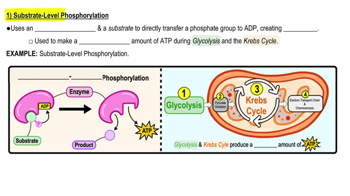
  • What are the two types of phosphorylation involved in aerobic cellular respiration?
    The two types of phosphorylation are substrate-level phosphorylation and oxidative phosphorylation.
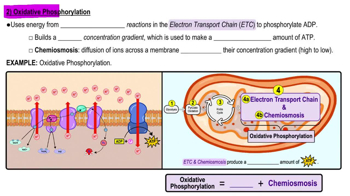
  • What is the primary purpose of oxidative phosphorylation in cellular respiration?
    The primary purpose of oxidative phosphorylation is to produce a large amount of ATP.
  • What are the two main steps involved in oxidative phosphorylation?
    The two main steps are the electron transport chain and chemiosmosis.
  • What role does the electron transport chain play in oxidative phosphorylation?
    The electron transport chain facilitates redox reactions that generate energy to form ATP.
  • How does chemiosmosis contribute to ATP production?
    Chemiosmosis involves the diffusion of hydrogen ions across a membrane, using the gradient to produce ATP.
  • In which stage of aerobic cellular respiration does oxidative phosphorylation occur?
    Oxidative phosphorylation occurs in the fourth and final stage of aerobic cellular respiration.