Skip to main content
Anatomy & Physiology
My Course
Learn
Exam Prep
AI Tutor
Study Guides
Textbook Solutions
Flashcards
Explore
Try the app
My Course
Learn
Exam Prep
AI Tutor
Study Guides
Textbook Solutions
Flashcards
Explore
Try the app
Back
Ventilation definitions
You can tap to flip the card.
Boyle's Law
You can tap to flip the card.
👆
Boyle's Law
A principle stating that pressure and volume are inversely related in a closed system.
Track progress
Control buttons has been changed to "navigation" mode.
1/15
Related flashcards
Related practice
Recommended videos
Ventilation quiz #1
Ventilation
14 Terms
Ventilation
22. The Respiratory System
1 problem
Topic
Lung Volumes and Capacities
22. The Respiratory System
2 problems
Topic
Bruce
22. The Respiratory System - Part 1 of 2
5 topics
9 problems
Chapter
Bruce
22. The Respiratory System - Part 2 of 2
1 topic
2 problems
Chapter
8:04
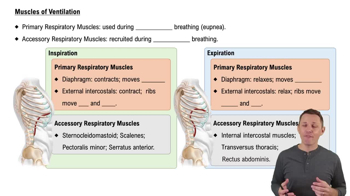
Muscles of Ventilation
2762
views
59
rank
8:33
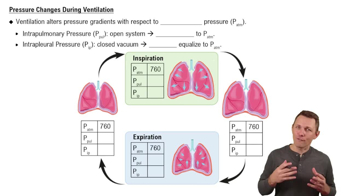
Pressure Changes During Ventilation
5121
views
70
rank
1
comments
4:53
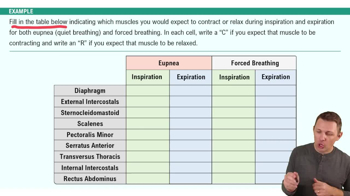
Ventilation Example 3
3706
views
59
rank
1
comments
Terms in this set (15)
Hide definitions
Boyle's Law
A principle stating that pressure and volume are inversely related in a closed system.
Diaphragm
A primary muscle of respiration that contracts to increase thoracic volume during inspiration.
Intrapulmonary Pressure
The pressure within the alveoli of the lungs, which changes with lung volume.
Intrapleural Pressure
The pressure in the pleural cavity, always negative relative to atmospheric pressure.
Atmospheric Pressure
The pressure exerted by the weight of the atmosphere, typically 760 mmHg at sea level.
Thoracic Cavity
The chamber of the body that houses the lungs and heart, changing volume during breathing.
Inspiration
The process of drawing air into the lungs by increasing thoracic volume.
Expiration
The process of expelling air from the lungs by decreasing thoracic volume.
Intercostal Muscles
Muscles located between the ribs that assist in expanding and contracting the rib cage.
Primary Respiratory Muscles
Muscles used during quiet breathing, including the diaphragm and external intercostals.
Accessory Respiratory Muscles
Muscles recruited during forced breathing to enhance thoracic volume changes.
Pleural Cavity
The space between the pleurae of the lungs, maintaining negative pressure.
Elastin Protein
A protein in lung tissue that contributes to lung recoil during expiration.
Sternocleidomastoid
A neck muscle that assists in elevating the rib cage during deep inspiration.
Rectus Abdominis
An abdominal muscle that aids in forced expiration by compressing abdominal contents.
 BackBack
 8:04
8:04