 Back
2.13 ATP
 04:57

Terms in this set (7)
the breakdown of complex molecules into smaller ones inside cells, releasing energy.
Catabolism
A bond that shares electrons
Covalent
A bond that exchanges electrons
Ionic
A covalent bond that stores an unusually large amount of energy
When the bond is later broken, the energy is released under controlled conditions
High-energy bond
In our cells, a high-energy bond usually connects a phosphate groups to an organic molecule
Most are derived from nucleotides (the building blocks of nucleic acids)
High-energy compound
The most important high-energy compound
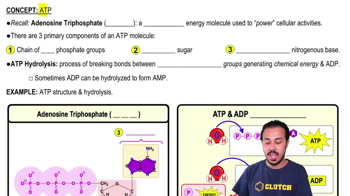
Composed of the nucleotide adenosine monophosphate
With additional two phosphate groups
Requires significant amount of energy
When the first group is added AMP turns into adenosine diphosphate
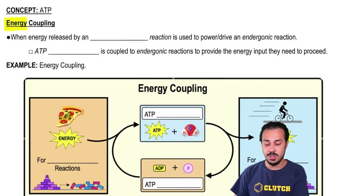
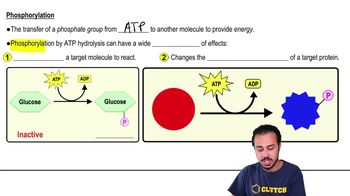
ATP (Adenosine Triphosphate)
The most important mother of storing energy in our cells?
The conversion of ADP to ATP